
Pine Alert Limitations for Crypto Perps: What TradingView Cannot Know
A guide to the limits of Pine Script alerts for crypto perp traders. What Pine can do, what it cannot see (funding, OI delta, cross-symbol breadth), and how a server-side scanner closes the gap without replacing the chart workflow.
Summary
Pine Script alerts are excellent at one job: firing on a condition the chart can see. They are not designed to fire on a condition the chart cannot see — funding rate, open-interest delta, cross-symbol breadth, server-side regime context. A trader who tries to build a perp scanner entirely in Pine ends up with an incomplete picture for a category where the missing factors are usually the decisive ones.
The right architecture is Pine on the chart, server scanner upstream. Pine handles the visual confirmation and the chart-side condition, the server scanner handles the factors that live outside the candle data. Confusing the two — treating Pine as a complete scanner or treating a server scanner as a chart replacement — leaves the trader either blind to half the signal or paying for a redundant view of the same chart.
What Pine alerts can do well
Pine Script alerts are reliable at firing on chart-resolvable conditions. A trader can encode an RSI threshold, an EMA cross, a candlestick pattern, a Bollinger band touch, a volume bar exceeding a baseline, and Pine will fire the alert when the bar closes meeting that condition. The implementation is well-tested, the latency is acceptable for swing-trading cadences, and the webhook output integrates cleanly with downstream automation when configured carefully.
For chart pattern triggers — a breakout above a level, a pullback into a moving average, a divergence pattern — Pine is genuinely the right tool. The condition is visible on the chart, the trader has full control over the logic, and the alert lives in the same environment the trader is already studying. Replacing Pine for these use cases with a server scanner would lose a workflow advantage without gaining a factor that matters.
Pine's strength is its locality. Every input the script sees is on the chart in front of the trader, which makes the alerts inspectable. A condition that fires can be visually confirmed by scrolling back and pointing at the bar. That auditability is genuinely useful, and a trader who abandons Pine entirely is giving up the chart-side audit surface for a server stream that may be opaque in different ways.
The chart-script architecture limit
The architectural limit of Pine is that it runs inside the chart. It sees the data series the chart displays — open, high, low, close, volume — and whatever computed series the script defines on top of those. It does not see data outside the chart context: the funding rate of the perp contract, the open interest curve, the spot-perp basis, the breadth of the broader perp universe, the BTC dominance reading, or any other factor that requires fetching a separate data source on a different cadence.
Pine has access to a few cross-symbol functions (request.security and similar), and a script can request data from other tickers within limits. But these cross-symbol calls run inside a single chart-render context, are subject to data-request limits, and cannot orchestrate the kind of universe-wide scan that "what is breadth right now across 500 perps" requires. The architecture is a chart-script, not a server-scanner; the limits follow from that.
The result is that any signal whose dominant factors live outside the chart is fundamentally weaker in Pine than it would be in a server scanner. A trader trying to encode a "low-breadth long-fade" rule in Pine will spend hours fighting the cross-symbol limits, end up with a degraded approximation, and still ship an alert that misses the regime context the rule depended on. The correct response is not to fight the architecture; it is to use Pine for what Pine is good at and put the cross-context logic in a server.
What Pine cannot see: funding rate
Funding rate is the most consequential factor Pine cannot natively see. The funding rate of a perpetual futures contract lives outside the candle data; it is published by the exchange on a separate cadence (typically every eight hours, sometimes hourly), and Pine has no first-class access to the funding curve for the chart it is displaying. A Pine script can in theory request an external symbol that approximates funding, but the workaround is fragile, the data is not always available, and it introduces a cross-symbol request budget the script may not be able to afford.
Funding rate matters for almost every perp setup. A breakout candle with funding at -0.03% and an OI drop is a squeeze; the same candle with funding at +0.05% and OI rising is a commitment breakout. The two have opposite trade-management implications, and Pine alone cannot tell the trader which is which. A chart-side alert that fires on "breakout candle" without seeing funding is firing into half the information.
The honest position is that a Pine breakout alert is a candle-detection alert, not a regime-conditioned signal. That is fine if the trader uses it as the candle layer in a multi-factor read. It becomes dangerous when the trader treats the Pine alert as if it were a complete signal, ignores the funding context, and chases candles in regimes where the candle itself was the trap.
- Funding is published on an 8-hour cadence outside the candle data.
- Cross-symbol Pine workarounds for funding are fragile and budget-limited.
- The same candle in opposite funding regimes is opposite setups.
- Pine alerts without funding context are candle-detection, not signal.
What Pine cannot see: open interest delta and notional
Open interest is the second factor Pine cannot see natively for the contract being charted. OI is published by the exchange on a rolling basis, and a server scanner can compute the OI delta over any window (1-hour, 4-hour, session). Pine, running inside a chart-render context, has the same problem it has with funding: the data is not local, the cross-symbol workarounds are limited, and the result is a degraded approximation at best.
The OI delta matters because it answers the "who is doing what" question that the candle cannot. Price up plus OI up is new longs entering (commitment). Price up plus OI down is shorts covering (squeeze). The two states look identical on the candle chart and require different trade-management; without OI context, a Pine alert that fires on a strong candle has no way to disambiguate them. The trader sees a green candle, fires the alert, and has no information about whether they are joining a trend or buying the top of an unwind.
Notional context — the minimum-dollar size of the OI move — is a related blind spot. A 6 percent OI swing on a thin-book altcoin perp can represent very small absolute capital flow and should be filtered as noise; the same 6 percent swing on a major perp represents real positioning. Pine has no notional context for cross-symbol scanning, which means an OI-based Pine alert (assuming the trader gets past the data-access problem) cannot filter by liquidity threshold even when the trader wants to.
What Pine cannot see: cross-symbol breadth and regime
Cross-symbol breadth — the percentage of perps in the universe positive over a window — is fundamentally a server-side computation. It requires fetching the current state of hundreds of contracts, aggregating, and publishing the ratio. Pine has no way to do this efficiently inside a single chart-render context; the cross-symbol request budget would be exhausted long before the breadth read could be assembled, and the result would be stale by the time the script finished.
Without breadth, Pine cannot gate by regime. The same RSI-divergence alert in a tape where 78 percent of perps are green and a tape where 22 percent are green will fire identically, even though the trade conviction in the two regimes is opposite. The trader receives the alert, scrolls to the chart, sees the candle, and has no information about whether the broader tape supports the named setup. The regime context — which is what conditions the conviction of every other factor — is the missing piece.
BTC dominance, BTC trend, the volatility regime label, and the suppression-reason layer are all in the same category. They live outside the chart, require cross-context computation, and are not within Pine's practical reach. A Pine-only workflow is by definition a regime-blind workflow, which is fine for chart-pattern detection and dangerous for anyone treating the alerts as standalone signals.
- Breadth requires server-side aggregation across hundreds of contracts.
- BTC trend / dominance require cross-symbol fetching and rolling math.
- Volatility-regime labels need universe-wide variance reads.
- Suppression-reason layers are by definition server-orchestrated.
Webhook and alertcondition rate limits
Beyond the data limits, Pine alerts have practical-mechanical limits worth understanding. Each TradingView account has a fixed alert quota that depends on the subscription tier; running dozens of Pine alerts across many charts can hit that quota faster than expected, especially when alerts include alertcondition()-style branching that the platform counts as separate alert instances.
Webhook payload size is constrained, and the payload format is fixed once the alert is created (editing the message requires reopening the alert dialog, which interrupts the trader). A complex payload that includes multiple symbol fields, timestamps, and price levels needs to be designed up front; reactively adding fields to an existing alert without losing the alert's firing history is a manual process. For a single chart-pattern trader this is fine; for someone trying to build out a multi-symbol scanner it becomes a maintenance burden.
Alert latency is acceptable for swing trading but is worth measuring before treating Pine as a real-time scanner. The bar-close confirmation requirement (some Pine alerts wait for the bar to close before firing to avoid repaints) introduces a delay that matters in fast tapes. A perp move that completes in 90 seconds can be over before the bar-close alert resolves on a 5-minute chart. The webhook walkthrough at /blog/tradingview-to-bybit-webhook covers these mechanics in more depth.
The right way to combine Pine with a server scanner
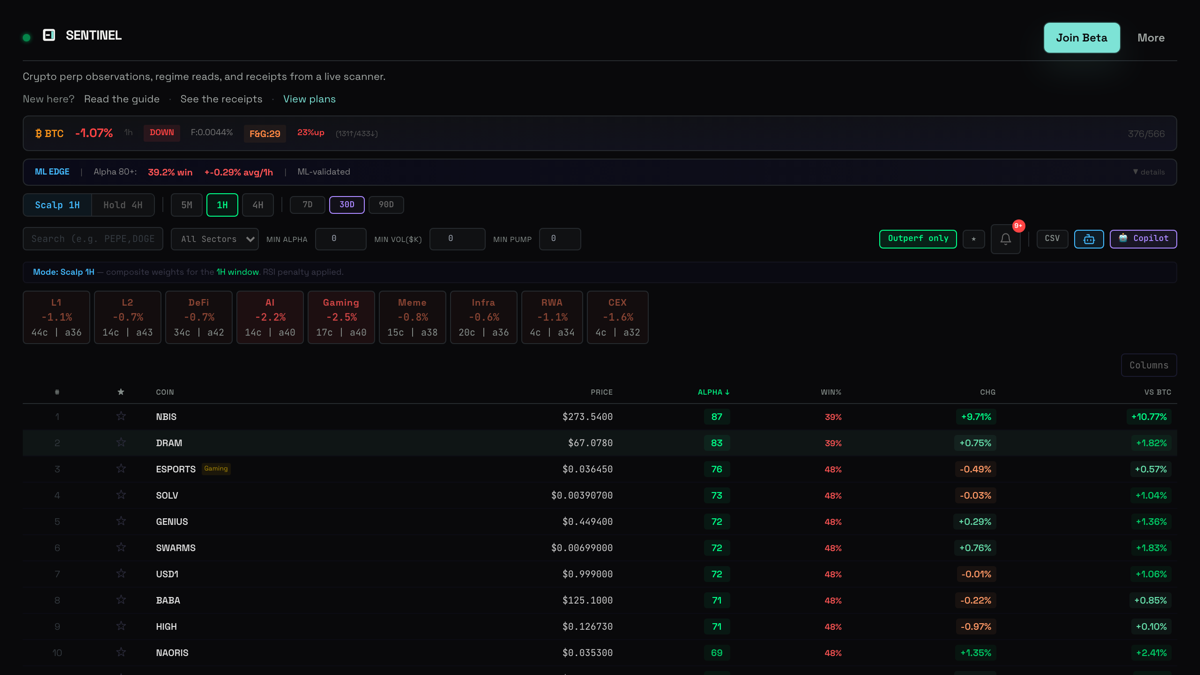
The right architecture is not "Pine vs server scanner." It is Pine plus server scanner. Pine handles the chart-side condition layer: the breakout level, the divergence pattern, the visual confirmation. The server scanner handles the factor layer: funding, open interest delta, breadth, regime, suppression reasons. The two surfaces complement rather than compete, and the trader gets a complete picture without forcing either tool to do work it was not designed for.
In practice this looks like a workflow where the server scanner publishes candidate observations with full factor context, and the trader uses Pine on the chart to confirm the entry timing and the local-level structure. The server scanner narrows the universe to the small set of observations that have factor support; Pine helps the trader pick the exact entry candle within that set. Neither tool is trying to do the other's job.
A trader who runs only Pine is doing chart-pattern detection on perps without the regime context that makes the patterns work. A trader who runs only a server scanner is missing the chart-side audit layer that turns a published observation into an actionable entry. The combination is what produces the workflow a working perp trader actually wants — and it is the workflow SENTINEL's product surface was designed around.
- Pine for chart-side conditions and visual confirmation.
- Server scanner for factor stack, regime, and suppression.
- Server scanner narrows the universe; Pine refines the entry.
- Neither alone is sufficient for a complete perp workflow.
SENTINEL's free Pine + paid Telegram split
SENTINEL ships a free open-source Pine trend script that traders can run on their own charts. That respects the deliberate architecture split — the chart-side reference is free, the server stack is the paid product — without forcing the trader to subscribe just to inspect a transparent trend tool.
The paid Telegram product is where the cross-context factors live: per-alert funding, open interest delta, volume ratio, regime tag, and suppression reasons. None of that is on a chart, because none of it is chart-resolvable; it is server-side computation published into Telegram as the primary subscriber surface. Internal model diagnostics remain separate from public proof claims. The receipts feed at /performance is the public audit layer that lets a trader inspect the system before committing to the paid stream.
A trader who uses the free Pine indicator alone gets the regime context on their chart and can run their own setups with the broader tape framing visible. A trader who adds the Telegram beta gets the full factor stack as observations delivered into a clean channel. The split is intentional: chart-side work is free, server-side work is the product, and the boundary between them is where the architecture limits naturally land.
Common misconceptions about Pine alerts
The most common misconception is that Pine can replace a server scanner with enough scripting effort. It cannot, because the limits are architectural rather than effort-bound. The funding rate is not in the chart context regardless of how much Pine code a trader writes; the cross-symbol budget is fixed regardless of how clever the request.security usage is; the breadth read is server-orchestrated by definition. Effort against architecture loses.
A second misconception is that a Pine alert with a webhook is "the same as" a server scanner. The webhook is the delivery channel, not the upstream computation. A Pine alert with a webhook pointing at a Discord bot is still a Pine alert; the only thing that changed is where the message lands. If the alert was fired by a chart-resolvable condition, it has chart-resolvable limits regardless of where the webhook delivers it.
A third misconception is that source visibility alone makes an indicator trustworthy. SENTINEL's hosted Pine script is open-source, but the trust question still comes down to output consistency, risk language, and whether the paid stream keeps receipts. Source visibility helps inspection; it does not replace an audit trail.
Risk boundary
Understanding Pine's limits reduces the probability of building a workflow that depends on signals Pine cannot deliver. It does not eliminate the risk that any specific alert — Pine, server, or combined — fails in a particular regime, that the trader misapplies the rule, or that the broader market moves on a cadence neither tool was tuned for. The architecture split narrows the read; it does not collapse the trade outcome to a single answer.
Bybit perpetual futures are leveraged products. A chart-side alert combined with a server-side factor read is more informative than either alone; it is not a guarantee. Treat Pine alerts, server-scanner observations, and the regime label as observations rather than instructions. Read the public receipts at /performance before trusting any tool that claims to publish perp signals — including this one — and read the risk disclosure before using the Telegram beta.
Try it live
Connect wallet first, then continue with Telegram to unlock trial/Core features.
How this was produced
Every claim was verified against the live SENTINEL codebase and the current product surfaces. This is educational product documentation, not financial advice.