
TradingView to Bybit Webhook: Execution Alerts vs Telegram Scanner Context
A practical guide to TradingView to Bybit webhooks, Telegram alert routing, and where funding, open interest, liquidation, and regime context fit.
Summary
A TradingView to Bybit webhook is usually an execution workflow: TradingView fires, a webhook receives the alert, and Bybit can turn the payload into an order if the account is configured for that path.
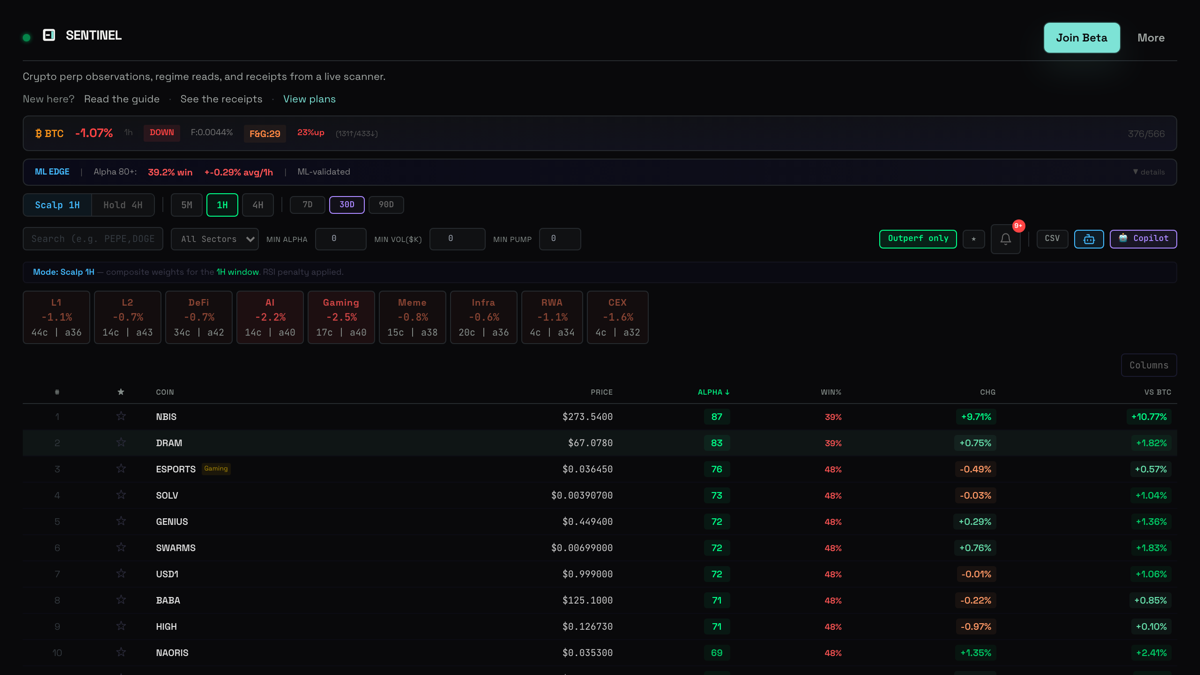
SENTINEL sits on the other side of the decision. It does not execute trades. It adds server-side market context - funding, open interest, liquidation pressure, volume, and regime - before a trader decides whether an alert deserves attention.
Why traders search for TradingView to Bybit webhooks
The search intent is clear: a trader has a TradingView idea and wants it to reach Bybit without sitting in front of the chart. Sometimes they want full automation. Sometimes they only want a Telegram message that tells them the setup fired. Those are different jobs, and mixing them together is how alert stacks become risky.
A TradingView to Bybit webhook can move an alert from chart logic into an exchange workflow. A Telegram crypto scanner does something else: it helps the trader decide whether the alert deserves attention by adding context that the chart alert may not have had when it fired.
The execution path: TradingView webhook to Bybit
In the execution path, TradingView is the trigger. A Pine strategy or alert condition fires, sends a webhook payload, and the receiving system turns that payload into a Bybit action. Bybit has its own Webhook Signal Trading flow for derivatives, and third-party tools also exist for routing TradingView alerts into Bybit through API keys or webhook connectors.
That path is powerful, but it is not a scanner. It does not automatically know whether funding is crowded, whether open interest is expanding, whether liquidations are already forcing the move, or whether the broader market regime is supportive. If the alert payload says go, the execution system is designed to execute or prepare that action according to its configuration.
- TradingView owns the chart condition.
- The webhook owns delivery and payload formatting.
- Bybit or a connector owns execution, logging, and account permissions.
- Risk controls have to be configured before the alert fires, not after.
Official constraints worth checking first
Before connecting any TradingView alert to an exchange, read the current exchange and TradingView docs directly. In the July 2026 refresh, Bybit still framed Webhook Signal Trading as derivatives strategy execution, not a generic notification bot. The setup also has practical constraints around supported contract types, one-way position mode, per-symbol setup, order failure cases, and signal delay.
TradingView webhooks are HTTP POST requests to a URL you provide. That sounds simple, but production reliability depends on the receiving endpoint, payload format, authentication, logging, and response time. Treat the webhook like execution infrastructure from the first minute, even if you are only testing with small size.
- Use official docs as the setup source of truth, because product limits can change.
- Do not paste secrets, credentials, or private risk settings into alert bodies.
- Expect failure modes: duplicate alerts, delayed alerts, rejected orders, malformed JSON, and connector downtime.
- Start with notification-only routing until the alert behavior is boringly predictable.
The notification path: TradingView webhook to Telegram
A safer first step for many traders is notification rather than execution. TradingView fires the same style of alert, but the webhook routes the message to Telegram, Discord, email, or another notification surface. The trader still decides what to do with the information.
This solves a real workflow problem. Phone push notifications disappear, chart alerts are easy to miss, and Telegram keeps a durable history across phone and desktop. The weakness is that a raw forwarded alert can still be thin: ticker, condition, timeframe, maybe a price. It often lacks the market structure that tells a trader whether the alert is useful.
What Pine and webhook alerts usually miss
TradingView Pine is excellent at expressing chart logic. It can see the symbol, timeframe, indicator state, and any higher-timeframe series the script requests. It is not naturally built to read the whole derivatives tape around the alert: funding, open interest delta, liquidation context, breadth across the perp universe, BTC regime, and cross-market pressure.
That matters on Bybit perps because the same chart alert can mean different things under different positioning. A breakout with rising open interest and calm funding is not the same observation as a breakout with overheated funding and falling open interest. The webhook can deliver both alerts; it cannot judge the difference unless that context is added somewhere else.
- Funding says who is paying to hold crowded exposure.
- Open interest says whether new positioning is entering or leaving.
- Liquidation context says whether the move is forced flow or clean participation.
- Regime says whether the wider market is helping or fighting the setup.
Where SENTINEL fits in the workflow
SENTINEL is not a TradingView to Bybit execution bridge. It does not place orders, manage leverage, submit stops, or connect to a trader's Bybit account. It is a scanner and Telegram research surface for traders who want market context before they act.
The scanner reads Bybit perpetual markets server side and ranks observations across momentum, relative strength, volume ratio, funding, open interest, RSI, liquidation pressure, and market regime. Telegram is the delivery surface for eligible observations and account workflow. The product value is not "fire every alert faster"; it is "send fewer alerts with more context".
When direct webhook execution makes sense
Direct execution can make sense when the trader already has a tested strategy, understands the order payload, has verified the exchange permissions, and is comfortable with automated risk. In that case the webhook is infrastructure, not alpha. The important work is position sizing, error handling, duplicate-fire prevention, and knowing exactly what happens when TradingView or the connector misbehaves.
A serious execution bridge should show logs, reject malformed payloads, keep API permissions narrow, avoid withdrawal access, and make it easy to pause the strategy. None of that removes market risk; it only makes the plumbing more predictable.
When a Telegram scanner is the better first step
A Telegram scanner is the better first step when the trader is still deciding which conditions deserve attention. Instead of automating orders, the trader watches live observations, compares them against the public receipt surface, and decides whether the workflow improves their read of the market.
That is the SENTINEL beta posture. Inspect the public scanner, read the current CORE receipts, join Telegram, and use the trial to decide whether the factor stack is useful. If a trader later wants to automate their own strategy, that is a separate execution problem.
The honest handoff
If you came here to automate execution from TradingView into Bybit, SENTINEL is not that bridge. Use the official exchange flow or a dedicated execution connector, and test it like infrastructure.
If you came here because raw alerts are too thin, too noisy, or missing funding, open interest, liquidation, and regime context, SENTINEL is built for that job. Start with the public scanner, inspect the current CORE receipts, then use the Telegram beta to see whether the context improves your market read before paying for anything.
- Execution problem: use a webhook bridge with account-level risk controls.
- Context problem: use SENTINEL to filter and explain scanner observations before action.
- Evaluation problem: read the public receipts first, then trial the Telegram beta.
Checklist before using any Bybit webhook or alert bot
Whether the tool is a webhook bridge, a Telegram forwarder, or a scanner, audit it before trusting it. The best products make their boundaries obvious. The worst ones blur execution, alerts, and performance claims into one sales page.
- Does it execute trades or only send notifications?
- Does it require Bybit API keys, and are permissions scoped safely?
- Does it show logs for received, rejected, retried, and delivered alerts?
- Does it explain duplicate-fire handling and failure modes?
- Does it include market context beyond the chart alert?
- Does it publish outcomes, including misses, before asking for payment?
Risk boundary
SENTINEL is a research and observation tool. It does not offer financial advice and does not execute trades. Bybit perpetual futures are leveraged products, and webhook automation can amplify mistakes because the system can act faster than the trader can intervene.
Treat any TradingView to Bybit webhook as execution infrastructure, not a guarantee. Treat SENTINEL observations as context, not instructions. Read the risk disclosure before using the beta, and never let an alert system define risk for you.
Common questions
What is a TradingView-to-Bybit webhook actually for?
It is an execution workflow: TradingView fires, a webhook receives the alert, and Bybit can turn the payload into an order if the account is configured for that path. A scanner with off-chart context is a different job.
What constraints should I check before connecting TradingView to Bybit?
Read the current exchange and TradingView docs directly, do not paste secrets or private risk settings into alert bodies, expect failure modes like duplicate alerts, delayed alerts, rejected orders, malformed JSON, and connector downtime, and start with notification-only routing until the alert behavior is boringly predictable.
When is a Telegram notification path better than direct webhook execution?
When the trader is still deciding which conditions deserve attention. Instead of automating orders, the trader watches live observations, compares them against the public receipt surface, and decides whether the workflow improves their read of the market.
What context do raw Pine and webhook alerts usually miss?
Funding (who is paying to hold crowded exposure), open interest (whether new positioning is entering or leaving), liquidation context (whether the move is forced flow or clean participation), and regime (whether the wider market is helping or fighting the setup).
Is SENTINEL a TradingView-to-Bybit execution bridge?
No. SENTINEL does not place orders, manage leverage, submit stops, or connect to a trader's Bybit account. It is a scanner and Telegram research surface for traders who want market context before they act.
When does direct webhook execution make sense?
When the trader already has a tested strategy, understands the order payload, has verified the exchange permissions, and is comfortable with automated risk. In that case the webhook is infrastructure, not alpha — position sizing, error handling, and duplicate-fire prevention are the important work.
Try it live
Connect wallet first, then continue with Telegram to unlock trial/Core features.
How this was produced
Every claim was verified against the live SENTINEL codebase and the current product surfaces. This is educational product documentation, not financial advice.