
Crypto Perp Scanner: How SENTINEL Filters Volume, Funding, OI, and Regime
A practical guide to reading crypto perp scanner output with momentum, volume, funding, open interest, market regime, and receipts.
Summary
A useful crypto perp scanner should not only rank green candles. It should show whether the move has liquidity, regime support, funding context, and a recorded outcome process.
SENTINEL is built as a public research desk around that idea: observations first, receipts after, and no buy or sell instructions.
What a crypto perp scanner should answer
Most traders do not need another watchlist sorted by 24h gain. They need to know whether a move is clean enough to investigate or already crowded enough to leave alone. A perp scanner is useful when it turns raw exchange data into a short list of observations that still carry their context.
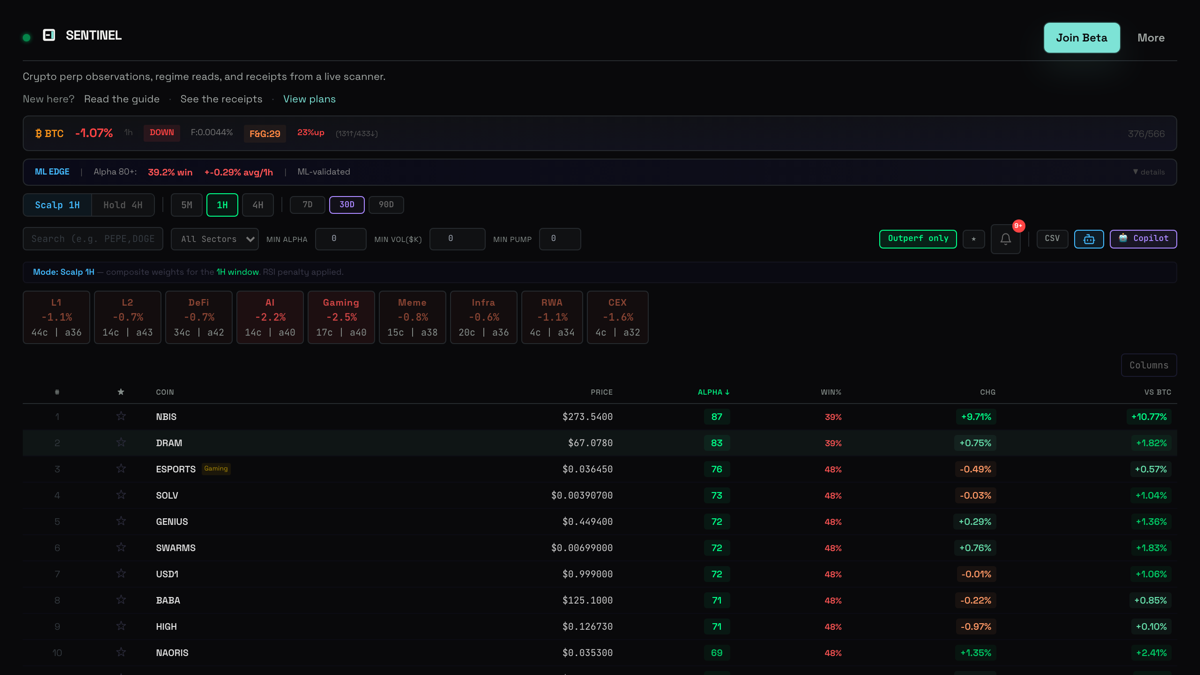
SENTINEL ranks crypto perpetual futures across price movement, relative strength, momentum, volume, funding, open interest, and market regime. It surfaces those observations together so the trader reads the tape with context instead of reaction, and decides for themselves.
Why regime matters before any ticker
A coin can look strong while the wider market is hostile. BTC trend, market breadth, volatility context, and suppression reasons change how much trust a setup deserves. That is why SENTINEL treats regime as a gate, not as an afterthought.
When the tape is narrow, eligible observations should narrow. When breadth improves, more scanner observations can become useful. This prevents the scanner from behaving like every green candle deserves the same attention.
- BTC context prevents isolated alt strength from being read in a vacuum.
- Breadth shows whether strength is broad or concentrated in a few symbols.
- Suppression reasons explain why a setup may be filtered even when a headline score looks attractive.
Volume, funding, and open interest are the crowd check
A strong move with thin volume can be fragile. A strong move with crowded funding can be late. A strong move with unstable open interest can be a squeeze, a trap, or a liquidation echo rather than clean demand.
SENTINEL keeps those factors visible beside the score. Volume ratio helps show whether participation is elevated. Funding helps show whether traders are paying up to hold one side of the perp. Open interest helps show whether positioning is entering or leaving the market.
- Volume ratio asks whether today is active relative to recent activity.
- Funding asks whether the market is paying a premium to stay long or short.
- Open interest asks whether the move is supported by fresh positioning or position closure.
How the factors combine into a single read
A scanner that prints seven columns and leaves the trader to reconcile them is just a spreadsheet with a refresh button. The work that matters happens when those factors are read against one another, because each one is ambiguous on its own. A high volume ratio is participation, but participation can be a breakout or a blow-off. Rising open interest is fresh positioning, but fresh positioning into elevated funding is often a crowd arriving late rather than early. The factors only become informative in combination, and the combination only becomes trustworthy once the surrounding regime has been checked.
SENTINEL composes those factors into one ranked observation per perp rather than asking the trader to hold six dashboards in their head. Price action and relative strength establish that something moved and that it moved relative to the rest of the tape, not just on its own chart. Volume ratio and open interest delta then qualify the move: whether the participation is elevated, and whether positioning is entering or leaving. Funding adds the cost-of-carry context — who is paying to hold the position the move implies. The regime gate sits above all of it, deciding how much of that stack to trust given BTC trend, breadth, and volatility. The output is a short list, ordered, with the factor stack visible beside each row so the read can be audited rather than taken on faith.
- The score is a composition of factors, not a single oscillator, so no one column can carry an observation by itself.
- Each factor is qualified by the next: volume by open-interest direction, open interest by funding, the whole stack by regime.
- The factor stack stays visible beside every row, so the trader can disagree with the ranking and see exactly why it landed where it did.
Why receipts beat claims
A scanner can sound convincing while still failing in live use. SENTINEL handles that by keeping a public receipt surface for resolved CORE observations. The performance page shows live closed-window results, including sample size and the worst row, instead of relying on old marketing constants.
That boundary matters. Crypto perps are noisy, thin samples can mislead, and backtests age quickly. Receipts are not promises. They are the record a user can inspect before deciding whether the 14-day CORE access is worth their time.
Where the Telegram bot fits
The website is the discovery and research surface. Telegram is the live subscriber surface. That is where CORE observations, regime notes, position cards, and follow-up context can reach a trader without requiring them to keep the dashboard open.
The onboarding path is simple: inspect the public scanner, read the receipts, join SENTINEL on Telegram, and use the 14-day CORE access to decide whether the workflow is useful.
What a crypto perp scanner does NOT do
Clarity about the boundary is part of the product. A perp scanner does not predict price, and SENTINEL does not claim to. It does not issue buy or sell instructions, set targets, or tell a trader how much to risk. It cannot see a trader's account size, leverage, or risk tolerance, and it does not pretend the next observation is independent of the last in a market this noisy. A ranked observation is a structured starting point for investigation — nothing more, and the product is more useful for being honest about that.
It also does not promise that a clean-looking setup will resolve well. Crypto perps are noisy, thin samples mislead, and backtests age quickly, which is exactly why the record is published live rather than frozen into a marketing number. The transparency standard cuts both ways on purpose: we publish our losing trades next to the wins, on the same page, and the /performance window can show red when the recent CORE cohort is weak. A scanner that could not be wrong would be a sales pitch, not a research tool, so the boundary is stated plainly instead of papered over.
- It does not predict price, set targets, or issue buy/sell instructions.
- It does not know your account size, leverage, or risk tolerance — sizing and risk limits remain yours.
- It does not promise a clean setup resolves well; the live record on /performance shows the real outcomes, losses included.
How it compares to a watchlist, an exchange screener, and an alert bot
The honest way to position a perp scanner is to say what it replaces and what it does not. A 24h-gain watchlist answers "what moved" and stops there; it carries no liquidity, positioning, or regime context, so a thin one-candle pump and a broad regime-supported move sort identically. An exchange screener adds filters but still leaves the trader to reconcile funding, open interest, RSI, and volume across separate views by hand, and it never records what happened after the move. A typical alert bot fires a ticker with urgency and no factor context, and rarely keeps a ledger of how its past alerts resolved.
A research-desk scanner sits in a different place. It reads the same exchange data those tools read, but composes the factor stack into one ranked observation, gates it on regime, and — the part that separates it from all three — keeps a public receipt of how observations resolved, wins and losses on the same page. The comparison is not about which tool is "best" in the abstract. It is about which question each tool actually answers, and whether it leaves a record you can audit afterward. For the deeper version of each comparison, the cluster articles below cover the watchlist-versus-receipts question and the free-versus-paid question directly.
- 24h-gain watchlist: answers "what moved," carries no context, keeps no record.
- Exchange screener: adds filters, but leaves factor reconciliation manual and records no outcomes.
- Alert bot: fires a ticker with urgency, usually without factor context or a resolved ledger.
- Research-desk scanner: composes the stack, gates on regime, and publishes the resolved record — losses included.
How to use SENTINEL responsibly
Treat every scanner row as information, not as an instruction. The useful question is not "should I buy this?" The useful question is "what did the scanner observe, what context supports it, and what risk would make this observation invalid for me?"
SENTINEL does not remove the need for position sizing, risk limits, or judgment. It makes the market structure easier to inspect. That is the product boundary.
Common questions
What should a useful crypto perp scanner answer?
Whether a move is clean enough to investigate or already crowded enough to leave alone. A perp scanner is useful when it turns raw exchange data into a short list of observations that still carry their context.
Why does market regime matter before any individual ticker?
A coin can look strong while the wider market is hostile. BTC trend, market breadth, volatility context, and suppression reasons change how much trust a setup deserves, which is why SENTINEL treats regime as a gate rather than an afterthought.
How do volume, funding, and open interest serve as a crowd check?
Volume ratio asks whether today is active relative to recent activity, funding asks whether the market is paying a premium to stay long or short, and open interest asks whether the move is supported by fresh positioning or position closure.
Why do receipts beat performance claims?
A scanner can sound convincing while still failing in live use. SENTINEL keeps a public receipt surface for resolved CORE observations that shows live closed-window results, including sample size and the worst row, instead of relying on old marketing constants.
Where does the Telegram bot fit alongside the website?
The website is the discovery and research surface. Telegram is the live subscriber surface where CORE observations, regime notes, position cards, and follow-up context can reach a trader without requiring them to keep the dashboard open.
How should I use SENTINEL responsibly?
Treat every scanner row as information, not as an instruction. The useful question is what the scanner observed, what context supports it, and what risk would make that observation invalid for you. SENTINEL does not remove the need for position sizing, risk limits, or judgment.
Try it live
Connect wallet first, then continue with Telegram to unlock trial/Core features.
How this was produced
Every claim was verified against the live SENTINEL codebase and the current product surfaces. This is educational product documentation, not financial advice.