
Bybit Perp Scanner: Reading Funding, Open Interest, RSI, and Volume Together
How to read a Bybit perp scanner that combines funding, open interest, RSI, volume ratio, and market regime instead of treating each factor in isolation.
Summary
A Bybit perp scanner is most useful when funding, open interest, RSI, and volume are read as one stack — not four separate dashboards a trader has to reconcile manually.
SENTINEL is a public crypto perp research desk that publishes the factor stack next to each observation and keeps the receipts visible before asking anyone to trial the Telegram bot.
Why traders search for a Bybit perp scanner
Bybit lists hundreds of USDT and USDC perpetual contracts, and most exchange screeners surface them sorted by 24h gain. That is the wrong order for a trader trying to decide whether a move is worth investigating. A perp scanner becomes useful when it answers a different question: of the contracts that just moved, which ones moved with structure underneath them, and which ones moved on a single thin candle?
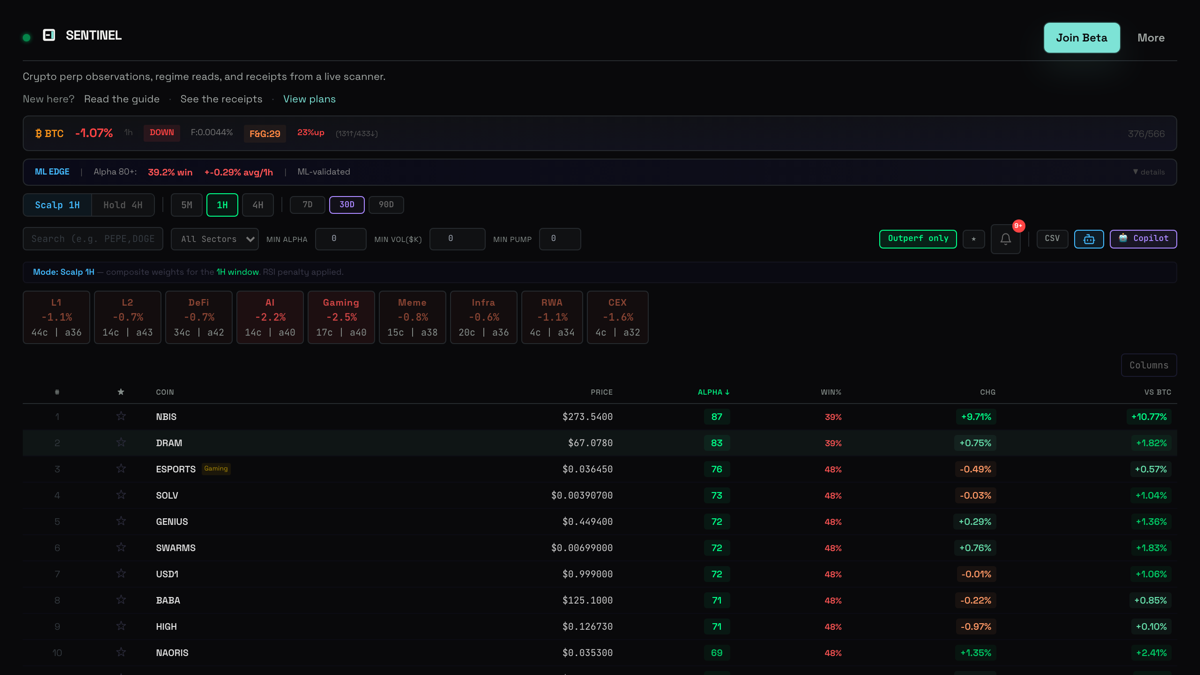
SENTINEL is built around that question. It is a public crypto perp scanner that ranks Bybit perpetual contracts across price action, momentum, relative strength, volume ratio, funding, open interest, RSI, and a cross-market regime gate. The point is not to predict outcomes for any single ticker. The point is to make the Bybit tape easier to read before a trader commits to a position.
Funding rate: who is paying to hold the position
Bybit funding is paid every eight hours and reflects which side of the perp is paying to maintain its exposure. Positive funding means longs are paying shorts; negative funding means shorts are paying longs. Read in isolation, funding is just a small periodic fee. Read alongside price and open interest, it explains whether a move is being chased by crowded leverage or absorbed by stable positioning.
A useful Bybit perp scanner does not score a contract higher just because funding is elevated. It uses funding as context. Strong momentum with calm funding looks different from strong momentum with funding running hot — the first reads as participation, the second reads as crowded positioning that is more vulnerable to a reset.
- Funding context turns a green candle into either "broad participation" or "crowded one-sided trade".
- Extreme funding does not by itself mean reversal — it means the move now needs an outside catalyst to keep going.
- Funding is most informative when read alongside open interest and the recent volume ratio, not on its own.
Open interest: is positioning expanding or unwinding
Open interest on a Bybit perp is the total notional value of contracts that are currently open. A rising open interest during a price move suggests new positioning is entering the market. A falling open interest during a move suggests positions are closing rather than adding. Neither pattern is good or bad in isolation, but together with price and volume they make a Bybit perp setup easier to classify.
SENTINEL surfaces the open interest delta beside the price change so an observation can be read as either "price up, OI up — new positioning" or "price up, OI down — likely short covering". The first tends to be slower and more durable; the second tends to be sharper and easier to fade once the squeeze runs out of forced buyers.
RSI: structure check, not a buy or sell signal
RSI is one of the oldest and most overused indicators in crypto. A scanner that flags every reading above 70 as "overbought" and every reading below 30 as "oversold" is creating noise rather than removing it. In trending Bybit perps, RSI can stay elevated for long stretches without the move ending. In ranging perps, RSI swings often reverse before any real structural break.
SENTINEL uses RSI as a structure check rather than an instruction. A contract printing a clean trending move on rising volume with stable RSI behaviour is different from a contract printing a vertical wick on a single RSI spike. The scanner keeps the value visible so a trader can interpret it inside the rest of the factor stack instead of acting on a single threshold.
- Treat RSI as one column in the factor stack, not as a signal generator.
- A high RSI on a healthy trend is information; a high RSI on a thin wick is noise.
- The relevant question is whether RSI agrees with volume, funding, and open interest — not whether it has crossed a fixed line.
Volume ratio: did the move bring its own bid
Volume ratio is the most underrated factor on a Bybit perp scanner. A loud move on below-average volume is a move that did not bring its own bid — it is a wick on a chart, not a participation event. A move on above-average volume tells a different story: traders are voting with size, the move is being expressed by real flow, and the next bar is more likely to attempt continuation rather than instantly fade.
SENTINEL reports the volume ratio relative to each contract's own recent activity so the score is comparable across thin and liquid perps. A volume ratio under one on a +5% candle is the same warning sign as a volume ratio over two on a +0.5% candle — both observations only become legible once volume is treated as a first-class column.
Regime gating before any single ticker
Even a clean Bybit perp setup loses most of its value when the wider market is hostile. SENTINEL keeps a cross-market regime read — BTC trend, breadth, BTC dominance, DXY, SPX, and a volatility proxy — and uses it as a gate on which scanner observations get promoted to subscriber-visible alerts. When breadth is thin, eligible observations narrow. When the regime improves, more observations become useful.
That ordering matters. A scanner that ignores regime will keep firing the same setups in every market and let the user pick. A scanner that respects regime will refuse to chase trades during conditions it has already learned to distrust. Bybit perps move quickly enough that this filter is the difference between a steady workflow and a stream of false starts.
Receipts before the Telegram trial
Anyone can publish a scanner that claims a win rate. The harder thing — and the boundary SENTINEL tries to hold — is publishing a closed-window receipt page that includes the sample size, the worst row, and how the score behaved on losing observations. The performance page is meant to be read before the Telegram trial, not after, so a trader can decide whether the scanner output deserves their attention at all.
That posture is intentional. Bybit perps are noisy, thin samples mislead, and any backtest figure stops being useful the moment market conditions change. Receipts are not promises. They are the inspectable record that lets a serious trader judge the scanner without relying on a sales thread.
Risk boundary — what this scanner is not
SENTINEL is a research and observation tool. It does not place trades, manage position size, set stops, manage leverage, or offer financial advice. Bybit perpetual futures are leveraged products and can lose more than the margin posted on a single trade. Every observation should be treated as information that needs to be checked against the trader's own risk limits before any action.
If a Bybit perp scanner ever sounds like it cannot be wrong, that is the moment to stop trusting it. SENTINEL is built to be wrong sometimes and to publish the receipts when it is. Read the full risk disclosure before using the Telegram beta, and never risk more than you can afford to lose on a single setup.
Common questions
Why use a Bybit-specific perp scanner?
Bybit lists hundreds of USDT and USDC perpetual contracts, and most exchange screeners surface them sorted by 24h gain. A useful scanner answers a different question: of the contracts that just moved, which ones moved with structure underneath them, and which ones moved on a single thin candle.
How should I read the Bybit funding rate?
Bybit funding is paid every eight hours and reflects which side of the perp is paying to maintain exposure. Strong momentum with calm funding looks different from strong momentum with funding running hot — the first reads as participation, the second reads as crowded positioning that is more vulnerable to a reset.
What does open interest tell me about a Bybit perp move?
A rising open interest during a price move suggests new positioning is entering the market; a falling open interest during a move suggests positions are closing rather than adding. "Price up, OI up" reads as new positioning; "price up, OI down" reads as likely short covering.
Should I treat RSI as a buy or sell signal?
No. SENTINEL uses RSI as a structure check rather than an instruction. A high RSI on a healthy trend is information; a high RSI on a thin wick is noise. The question is whether RSI agrees with volume, funding, and open interest — not whether it has crossed a fixed line.
Why does volume ratio matter for perp scanner reads?
A loud move on below-average volume is a move that did not bring its own bid — a wick on a chart, not a participation event. A move on above-average volume tells a different story: traders are voting with size, and the next bar is more likely to attempt continuation rather than instantly fade.
How does regime gating change which Bybit setups get promoted?
When breadth is thin, eligible observations narrow. When the regime improves, more observations become useful. A scanner that ignores regime will keep firing the same setups in every market and let the user pick; a scanner that respects regime will refuse to chase trades during conditions it has already learned to distrust.
What is this scanner not?
SENTINEL is a research and observation tool. It does not place trades, manage position size, set stops, manage leverage, or offer financial advice. Bybit perpetual futures are leveraged products and can lose more than the margin posted on a single trade.
Try it live
Connect wallet first, then continue with Telegram to unlock trial/Core features.
How this was produced
Every claim was verified against the live SENTINEL codebase and the current product surfaces. This is educational product documentation, not financial advice.