
TradingView Crypto Alerts to Telegram: What Pine Can and Cannot Catch
How TradingView Pine alerts reach Telegram, what bar-state alerts can see, and where funding, open interest, and regime fill the gap.
Summary
Pine alerts move price and indicator state into Telegram quickly. They cannot see funding crowding, open interest delta, breadth, or the cross-market regime — and that gap is where crypto perp setups quietly fail.
SENTINEL composes the missing context on a server side, attaches it to each observation, and only routes it to Telegram subscribers when the factor stack agrees.
Why traders search for TradingView alerts that land in Telegram
TradingView is the place most crypto perp traders read the chart. Telegram is the place they read everything else. The reason traders want the alert to bridge the two is simple: nobody stares at the chart all day, and a phone push notification stops being legible the moment the screen turns off. Telegram keeps the alert as durable history, makes it available across phone and desktop, and lets a small trading group share the same observation without exposing the TradingView account.
This guide explains how that bridge actually works, what Pine alerts can and cannot see at firing time, and where a Telegram-side scanner adds factor context that Pine does not have access to. The goal is to make the workflow legible, not to sell a signal.
The standard Pine to webhook to Telegram pipeline
The common pipeline has three steps. A TradingView Pine script declares an `alertcondition` or calls `alert()` when its logic fires. The alert posts a webhook to a server the trader controls, or to an intermediate adapter that forwards into Telegram. A Telegram bot then relays the formatted message into a chat that the trader or their group is listening to.
Two practical notes are worth being honest about. First, check the current TradingView and exchange docs before building around webhooks: TradingView documents webhooks as HTTP POST alerts to a URL you provide, while Bybit's Webhook Signal Trading guide currently frames exchange execution through TradingView as requiring a paid TradingView plan. Second, "bridge it yourself" looks easy until the webhook server has to survive restarts, dedupe duplicate fires, format messages, and recover from transient Telegram API errors. Any tool that delivers Pine alerts into Telegram is solving some version of that plumbing.
- TradingView Pine alert fires on bar close or intrabar condition.
- Alert payload posts to a webhook endpoint the trader owns or rents.
- A Telegram bot formats the payload and posts it into a chat.
What Pine can actually see at alert time
Pine sees what the chart hands it. That includes the current symbol's OHLCV at the chart timeframe, indicator values computed from that series, drawing and structure context written inside the script, and multi-timeframe pulls fetched via `request.security`. Used carefully, this is enough to express a precise idea about price action — bar-close confirmations, indicator crossovers, multi-timeframe agreement, and structure breaks are all within reach.
The right read on Pine is not that it is weak. The right read is that Pine sees the chart it is on, and only the chart it is on. Anything that lives outside that chart's data feed has to be brought in by the script author or stitched on after the alert fires.
- Bar-close and intrabar confirmations on the chart timeframe.
- Indicator crossovers and basic structure logic.
- Multi-timeframe agreement via `request.security`.
- Custom on-chart drawings and ranges defined inside the script.
What Pine cannot catch
The factors that most often decide whether a crypto perp move sustains are not on the chart. Funding rate skew across exchanges, open interest delta and recent direction, breadth across the perp universe, and a cross-market regime read are all outside Pine's default visibility. So is orderbook microstructure and most liquidity context. A Pine alert that fires on a clean structure break has no way to know whether funding has been crowded long for three windows, whether open interest just dropped during the move, or whether breadth across the rest of the perp universe is supporting the breakout.
These are not Pine bugs. They are data the script does not have access to. The honest framing is that Pine is excellent at expressing chart-based ideas and not built to express off-chart ones.
- Perpetual funding rate context across exchanges.
- Open interest delta and recent direction beside the price move.
- Cross-market regime read: BTC trend, breadth, BTC.D, DXY, SPX, vol proxy.
- Liquidity and orderbook microstructure beyond the chart.
Why those gaps matter for crypto perps specifically
A green Pine alert during crowded funding is a different trade from the same green alert under calm funding. A breakout under thin breadth fades more often than the same breakout under broad participation. A clean move with open interest dropping during the candle is more likely to be position closure than fresh demand. None of these readings are predictions; they are interpretations that change how much trust an observation deserves.
Crypto perps are noisy and fast. A workflow that ignores off-chart factors will keep firing alerts in any market, regardless of whether the rest of the tape supports them. A workflow that respects those factors will refuse to escalate observations during conditions it has already learned to distrust.
How SENTINEL composes the missing context before Telegram
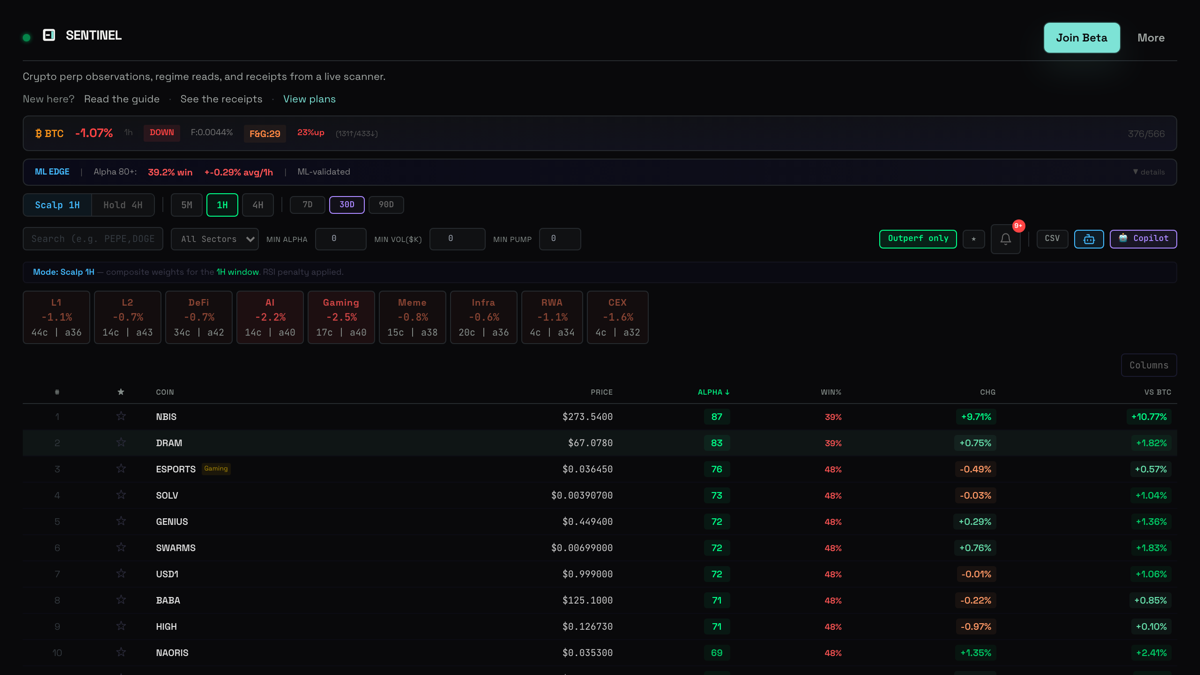
SENTINEL's scanner runs on a server side that reads exchange feeds directly. It grades each Bybit perpetual contract across price action, momentum, relative strength, volume ratio, funding, open interest, RSI, and a cross-market regime gate. Only when the factor stack agrees does an observation get promoted into the Telegram delivery path. The Telegram bot is the surface; the data work happens earlier, off the chart.
SENTINEL also hosts a free open-source Pine trend script for traders who already work in TradingView. The server-side factor stack remains in the scanner and Telegram workflow; the Pine tool is a transparent chart-side reference, not the paid product. If the workflow makes sense, the next step is the Telegram beta.
Workflow comparison: pure Pine to Telegram vs SENTINEL
Pure Pine to Telegram is an excellent workflow for trader-defined custom logic. The trader owns the Pine script, the webhook server, the bot, and the formatting. Everything that fires is something the trader explicitly chose to look for. The cost is plumbing time and the absence of off-chart factors at alert time.
SENTINEL is built for traders who do not want to maintain a webhook server and want funding, open interest, and regime attached automatically. The factor stack is fixed, the receipts are public, and the delivery path is the Telegram bot. The cost is that the logic is SENTINEL's, not the trader's. Both workflows are reasonable; they answer different questions.
- Pure Pine to Telegram: full custom logic, no off-chart factors at alert time, self-hosted plumbing.
- SENTINEL: fixed factor stack, off-chart context attached server side, public receipts, hosted delivery.
- A trader can use both — the SENTINEL indicator on-chart, the Telegram beta for off-chart context.
Receipts before the Telegram trial
A scanner that reaches Telegram should be inspectable before a trader joins. SENTINEL keeps a public CORE receipt window on the performance page that includes the sample size, the wins, the losses, and the worst row inside the current measurement window. The point is not to brag about a single screenshot; it is to let a trader audit the workflow against published outcomes before paying for anything.
Receipts are not promises. They are the record a trader can read with their own eyes, then decide whether the Telegram trial earns their attention.
How to evaluate any TradingView to Telegram product
Most of the work in choosing an alert workflow is auditing the product as if it were a trading system. A short checklist tends to surface the weak ones quickly. Apply it to SENTINEL too — that is the point of publishing it.
- Does each alert include factor context, or only a ticker and a direction?
- Are outcomes recorded after the alert, including the losing ones?
- Is the workflow honest about what Pine can and cannot see?
- Is there a public page to inspect before paying?
- Does the product avoid buy, sell, target, and guaranteed-return language?
Risk boundary — what this scanner is not
SENTINEL is a research and observation tool. It does not place trades, manage position size, set stops, manage leverage, or offer financial advice. TradingView Pine alerts are useful inputs to a trader's own process; they do not replace risk limits or judgment. Crypto perpetual futures are leveraged products and can lose more than the margin posted on a single trade.
If a TradingView-to-Telegram product ever sounds like it cannot be wrong, that is the moment to stop trusting it. Read the full risk disclosure before using the Telegram beta, and never risk more than you can afford to lose on a single setup.
Common questions
Why bridge TradingView alerts into Telegram?
TradingView is the place most crypto perp traders read the chart, and Telegram is the place they read everything else. Telegram keeps the alert as durable history, makes it available across phone and desktop, and lets a small trading group share the same observation without exposing the TradingView account.
How does a Pine-to-Telegram pipeline actually work?
A TradingView Pine script declares an alertcondition or calls alert() when its logic fires. The alert posts a webhook to a server the trader controls or to an intermediate adapter, then a Telegram bot relays the formatted message into a chat. Plan availability and exchange-webhook requirements should be checked in the current TradingView and Bybit docs before setup.
What can a TradingView Pine alert actually see at firing time?
Pine sees the current symbol's OHLCV at the chart timeframe, indicator values computed from that series, drawings and structure context written inside the script, and multi-timeframe pulls fetched via request.security. Pine sees the chart it is on, and only the chart it is on.
What can Pine not see that matters for crypto perps?
Perpetual funding rate context across exchanges, open interest delta and recent direction, breadth across the perp universe, the cross-market regime read (BTC trend, breadth, BTC.D, DXY, SPX, volatility proxy), and orderbook microstructure beyond the chart.
How does SENTINEL compose the missing context before Telegram?
SENTINEL's scanner runs server side, reading exchange feeds directly. It grades each Bybit perpetual contract across price action, momentum, relative strength, volume ratio, funding, open interest, RSI, and a cross-market regime gate. Only when the factor stack agrees does an observation get promoted into the Telegram delivery path.
Should I use pure Pine-to-Telegram or SENTINEL?
Pure Pine-to-Telegram is excellent for trader-defined custom logic with no off-chart factors at alert time and self-hosted plumbing. SENTINEL is built for traders who do not want to maintain a webhook server and want funding, open interest, and regime attached automatically. Both workflows are reasonable; they answer different questions.
Try it live
Connect wallet first, then continue with Telegram to unlock trial/Core features.
How this was produced
Every claim was verified against the live SENTINEL codebase and the current product surfaces. This is educational product documentation, not financial advice.