
Bybit Open Interest Alerts: When New Leverage Confirms, Crowds, or Exits
Open interest is not directional on its own. A guide to reading OI alerts as a four-state machine — confirm, crowd, exit, fade — so the same delta does not get traded the same way in every regime.
Summary
A Bybit open interest alert tells a trader that new contracts just opened or closed on a perp. It does not tell them whether new longs joined, whether old shorts covered, whether the move is starting or finishing, or whether the trade is now crowded. Those answers come from pairing the OI delta with price and funding in the same window.
Treating open interest as a single number is the mistake. Treating it as a four-state machine — confirm, crowd, exit, fade — turns the same alert into a different read depending on what the rest of the factor stack is doing. The state determines whether OI confluence is a green light, a yellow light, or a fade.
What an open interest alert actually tells you
Open interest on a Bybit perp is the total notional in open positions on that contract. A rising OI alert tells you that, in the window the scanner measured, the number of open contracts grew. A falling OI alert tells you the opposite — positions are being closed faster than new ones are being opened.
What the OI alert does not tell you is whether the new positions are longs or shorts. Every contract has both sides; the OI count does not distinguish them. A rising OI print is consistent with new longs entering, new shorts entering, or both. The directional read only resolves when OI delta is paired with the price change over the same window.
Most off-the-shelf OI alerts publish only the OI number. A trader who acts on that alone is acting on half the signal. The other half — price direction during the OI move, plus where funding is sitting — is what turns the alert from a notification into a state read.
The four OI states
Pairing OI delta with the price change over the same window collapses the alert space into four states. Each state has a different meaning, a different setup geometry, and a different trade-management implication. Memorising the four states is the cheapest upgrade a perp trader can make to how they read OI.
The states are not symmetric. Confirm and exit are both constructive reads in opposite directions. Crowd and fade are both warning reads, but they warn about different risks — crowd warns about saturation on the long side, fade warns about positioning capitulation on the long side. Reverse the price sign for shorts and the same map applies.
These reads describe positioning context only. They do not predict the next candle. What they do is keep the trader from buying a finishing flow as if it were a starting flow, or from chasing a crowded trade as if it were a fresh one.
- Confirm — price up + OI up = new longs joining a move (commitment, real trend).
- Crowd — price up + OI up + funding extremely positive = leverage piling on (vulnerable to counter-squeeze).
- Exit — price up + OI down = short cover (squeeze setup, finishing flow).
- Fade — price down + OI down = long capitulation (positioning unwind).
Why OI alerts without price context are noise
A pure "OI rose 5%" alert tells you something happened. It does not tell you whether it is a setup or a finishing flow. The same delta in three different price contexts has three different meanings, and a scanner that publishes only the OI number forces the trader to look up the rest by hand — which usually means they will not, and they will trade the OI number as if it were directional.
Rising OI during a sideways price tape often means positions are being built around a level, before any breakout. The new positioning is not yet committed to a direction, but it is accumulating; that is why range expansions often follow a quiet OI build. Rising OI during a fast move higher is different — late entries are piling onto a move that has already happened, which typically clusters near the local high and is more likely to mark exhaustion than the start of a new leg.
Falling OI during a fast move higher is the most misread case. The candle looks like a breakout; the OI says the opposite. Positions are being closed during the move, which means shorts are covering and the move is finishing rather than starting. A trader who chases that candle without reading OI is buying the top of an unwind. The same alert as a "breakout" is a setup; with OI context it is a fade.
The crowded-trade tell
A trade becomes crowded when positioning saturates. The marker is OI sitting at multi-week highs, funding extremely positive, and price up. All three at once means new longs have been entering for long enough and aggressively enough that the marginal new long is paying a meaningful premium just to be in the trade. The next move is more often a counter-squeeze — long capitulation as funding cost forces the weakest hands out — than continuation.
The mirror case is OI at multi-week highs on the short side: very negative funding, price down, and OI elevated. That is a crowded short, and the next move is more likely a short squeeze than a continuation lower. The /blog/bybit-liquidation-alerts walkthrough covers how the cascade plays out when a crowded short side starts to unwind, including why the first few percent of cover-buying often drag the rest of the short book in behind it.
The key idea is that exhaustion in a crowded trade comes from positioning saturation, not from chart patterns. A trader who only reads price will see a clean trend; the OI plus funding state machine flags that the trend is now expensive to be in, which is the actual exhaustion signal. The state-machine read is leading; the chart pattern is lagging.
OI delta vs absolute OI
Two scanners can show the same absolute OI level on the same contract and tell very different stories. One scanner that publishes a static notional read tells the trader nothing actionable; the level is a static read that means whatever the trader assumes it means. A scanner that publishes "OI rose 6% in the last hour" tells the trader that positioning is being added right now, in a window short enough to act on.
The delta is what matters for state-machine reads. "OI is high" is a property of the contract; "OI just rose 6% in the last hour" is an event. Events are what get paired with price moves to produce the four-state read. A scanner that publishes only absolute OI is publishing a thermometer; a scanner that publishes OI delta against a rolling baseline is publishing a signal.
Equally, "OI just fell 4% during this candle" is a different read from "OI is low." A falling OI delta during a fast move is the exit-state tell, regardless of whether the absolute OI level happens to be high or low at the moment. The window in which the change happens is what makes the read tradable, not the absolute level.
OI in a market regime
The same OI delta means different things in different regimes. Rising OI on a single name during a high-breadth crypto rally — say most of the perp universe green and BTC up — typically confirms the move. There is a broader bid supporting follow-through, and new positioning has tape behind it. The confirm state in a strong regime can extend for hours.
The same OI delta during a thin-breadth chop is often faded. With breadth low and BTC indecisive, a single-name OI rise is not backed by a broader risk-on tape, and the move is more likely to be a setup-and-fade than a sustained trend. The state-machine label is the same; the conviction layer above it is different.
In a downtape, rising OI on a single name is sometimes just a short setup in disguise. New shorts entering produce the same OI delta as new longs entering, and without confirming volume, funding direction, and the broader regime read, the trader can mistake a fresh short build for a long confirmation. Regime sets the floor for whether OI confluence can extend; without that read, the alert is incomplete.
What to look for in an OI scanner before paying for one
Before paying for any open interest scanner, run the same due-diligence pass covered in /blog/free-crypto-scanner-vs-paid-signals. The questions are different from "is this scanner accurate?" because there is no single right answer for OI — the question is whether the scanner publishes the inputs a trader needs to act on the four-state read.
Specifically: does it compute OI delta against a rolling baseline, or does it just publish the instantaneous OI number? Does it pair OI delta with price change and funding inline, or does it expect the trader to look those up separately? Does it surface OI extremes (the crowded-trade flag) or only OI changes? Does it gate by regime, or does it fire identical-looking alerts in any tape? Does it publish receipts on OI alerts that did not resolve, so the trader can see the misses, not just the wins?
A useful side question: does the scanner apply a notional threshold? An OI swing on a thin-book contract can look dramatic in percentage terms but represent very small absolute capital flow. A scanner that surfaces those without a filter trains the trader to chase noise. A scanner that filters by minimum notional, or at least flags thin-book context, respects the trader's time.
- OI delta against a rolling baseline, not instantaneous OI.
- Inline pairing with price change, funding, and volume.
- Crowded-trade flag based on OI extreme + funding extreme.
- Public receipts that include the OI alerts that did not resolve.
How SENTINEL uses open interest
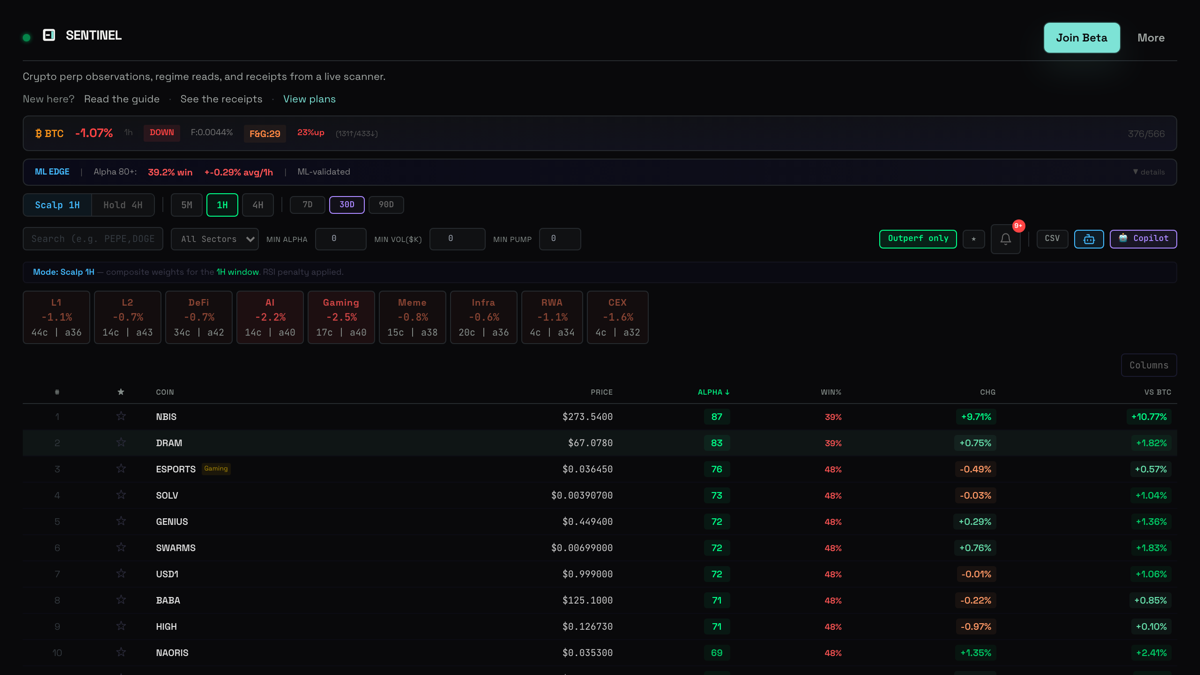
SENTINEL scans Bybit perpetual markets server side and computes OI delta on a rolling window for every contract in the universe. The OI delta is paired inline with the price change in the same window, the funding rate level and direction of change, the volume ratio against a trailing baseline, and a market-wide regime label built from BTC move, breadth, and volatility. The state-machine read is computed, not left to the trader to assemble.
OI extremes — crowded-trade configurations where OI is at multi-week highs and funding is at the same time extreme — feed into the alert score so that saturation context is part of every observation. Squeeze-pattern observations, where price is up and OI is down with funding flipping, route into the liqsqueeze tier. Broader factor-stack observations route through the sweet and Momentum Leaders (super) tiers. The same OI delta lands in different surfaces depending on which state it belongs to.
Resolved CORE observations that include OI-delta context are audited on /performance as part of the rolling CORE-tier receipts feed. The hosted SENTINEL Trend Pine script is free and open-source for chart-side trend context, while the full factor stack stays in the scanner and Telegram stream. The state machine itself is not a prediction engine; it is an observation surface that publishes its work.
Risk boundary
Open interest is observation, not instruction. The four-state read reduces the probability of misreading a positioning move; it does not eliminate failed setups, predict outcomes, or guarantee any specific entry. A confirm-state read still fails when the broader tape rolls over; a crowd-state read still extends sometimes before it cracks. The state map narrows the read; it does not collapse it to a single answer.
Bybit perpetual futures are leveraged products. OI confluence reduces the probability of misreading positioning, but the underlying instrument still produces both the largest single-trade winners and the worst single-trade losses for traders who size on confidence rather than on risk. Treat the four-state read as a context layer over price, not a substitute for risk management. Read the public receipts before trusting any tool that claims to publish OI signals — including this one — and read the risk disclosure before using the Telegram beta.
Try it live
Connect wallet first, then continue with Telegram to unlock trial/Core features.
How this was produced
Every claim was verified against the live SENTINEL codebase and the current product surfaces. This is educational product documentation, not financial advice.