
Reading the Crypto Regime: BTC + Breadth + Volatility
A guide to the crypto market regime read, why BTC trend, breadth, and volatility sit above every ticker decision, and how SENTINEL gates alerts on that read.
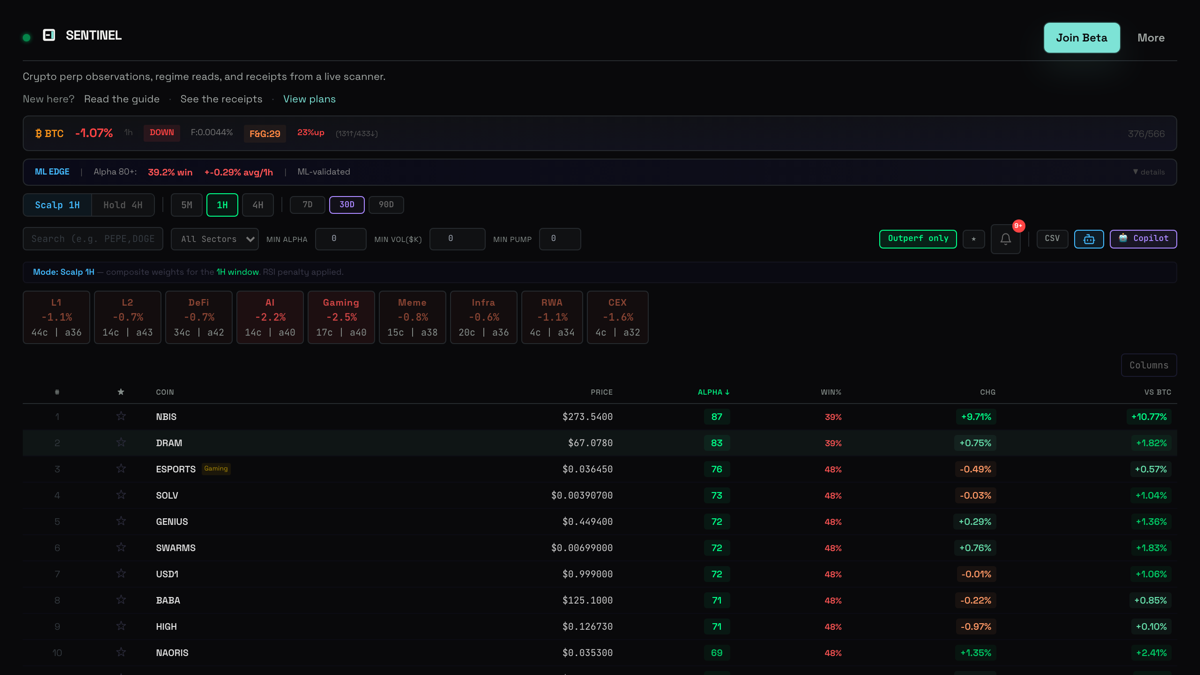
Summary
A scanner that ignores market regime keeps firing the same alerts in every tape and lets the user filter manually. A scanner that respects regime narrows what is eligible when the wider market is hostile and broadens again when the tape supports it.
SENTINEL composes a cross-market regime read from BTC trend, breadth across the perp universe, BTC dominance, volatility proxy, and macro context, and uses it as a gate on Telegram CORE alerts.
Why regime sits above every alert
Crypto perps move fast and noisily. A clean factor stack on a single ticker can be the right read for that ticker and still produce a bad trade because the wider market is hostile. The regime question is not about predicting BTC. It is about asking whether the conditions support the kind of move the alert is describing, and whether the trader should narrow position size or skip the setup entirely.
A scanner that ignores regime treats every market state the same way. That is comfortable to build and easy to market, because the alert volume stays high. The cost is that the user does the regime filtering manually, and most users do not. A scanner that respects regime accepts a lower alert count in hostile tape and a higher one in supportive tape, and is honest about why.
Regime is also the answer to a common buyer question: "why did the bot go quiet for a day?" The honest answer is usually that the conditions did not support the setups the scanner was looking for, and shipping an alert anyway would have been padding the feed.
The three legs: BTC trend, breadth, volatility
A useful regime read does not collapse into a single indicator. The three legs that matter most are BTC trend, breadth across the perp universe, and a volatility context. None of the three is sufficient on its own. BTC trend without breadth can mislead during decoupled alt phases. Breadth without BTC can mislead during squeeze rallies that do not have macro support. Volatility without the other two is just a description of how noisy the tape has been.
Read together, the three legs describe the floor under any single alert. A trader does not need to forecast where each leg is going. They need to know whether the floor is firm enough to act on the setup in front of them.
- BTC trend: gravity for the rest of the universe, not destiny.
- Breadth: how many perps are participating in the move, not just the symbol on the chart.
- Volatility: the cost of being wrong, expressed as the size of the average daily range.
BTC: gravity, not destiny
BTC is the largest perp, the deepest book, and the macro reference for the rest of the crypto universe. A BTC trend that is up and supportive does not guarantee that every alt continues, but it sets the floor higher. A BTC trend that is down and hostile does not guarantee that every alt collapses, but it makes individual breakouts more fragile because they are running into a current.
SENTINEL reads BTC trend across multiple windows because a single timeframe is easy to fool. A clean intraday up move on BTC during a multi-day downtrend is a different read from the same intraday move during a multi-day uptrend. The point is not to be clever about BTC. The point is to keep the gravity term honest.
A regime read that relies on a single moving average crossover or a single timeframe pivot is fragile. The strongest reads usually combine a short-term tape check (intraday) with a structural tape check (multi-day) and require both to lean the same way before calling the regime supportive or hostile.
Breadth: the second column
Breadth across the perp universe is the single most underused regime input in retail crypto. A move on one ticker means very little if it is the only ticker moving. The same move with broad participation across the universe is a different observation entirely. Breadth is what tells a trader whether a setup is part of a broader rotation or an isolated wick.
SENTINEL computes breadth as the share of liquid perps printing the same kind of move inside the current window, alongside a separate measure of how concentrated the breadth is among the top decile. Both numbers matter. A high breadth with concentrated leadership reads differently from a high breadth with even distribution. The Bybit perp scanner factor stack article on the blog walks through how breadth interacts with the rest of the columns.
Volatility: the cost of being wrong
Volatility is the most overlooked regime leg because it does not produce a direction. A wide-volatility tape rewards smaller position sizes and tighter risk, because every level breaks easier. A compressed-volatility tape rewards patience and lets a clean setup play out without getting wicked out of a position. Neither state is good or bad. The trader needs to know which one they are in before sizing the trade.
SENTINEL keeps a volatility proxy in the regime read because the same alert deserves a different position size depending on whether the tape is calm or wild. The factor stack does not change when volatility changes; the threshold for trusting any single alert does.
There is also a less obvious volatility effect that matters for alert design itself. A wide-volatility tape produces more setups that look like factor agreement on a single bar but break by the next bar. A scanner that does not damp its escalation threshold during high-volatility states will fire more alerts and then watch them fail in real time. A scanner that does damp the threshold ships fewer alerts and is being honest about the tape; the trader notices the difference in their own results, not in the marketing copy.
Cross-checks that prevent false reads
A regime read built from one or two columns is easy to fool. SENTINEL's regime composer includes cross-checks that catch the obvious failure modes. BTC dominance helps separate "alts running because rotation is on" from "alts running because BTC is leading and dragging the rest". A macro overlay (DXY, SPX, and a volatility proxy) helps catch the cases where crypto is moving independently of the broader risk environment.
None of these cross-checks predict the next move. They keep the regime read from confusing one kind of tape for another. A confident regime read that turns out to be wrong is far more expensive than a cautious read that does not over-promise.
Cross-checks are also where most regime products quietly fail. A composer that only looks at BTC will be fooled by alt-led runs; a composer that only looks at breadth will be fooled by a thin-leadership squeeze; a composer that only looks at macro will miss crypto-native catalysts. The point of the cross-check layer is to keep any single column from over-weighting itself in the final read, which is exactly the failure mode most retail regime tools never address.
Regime transitions: the hardest day to scan
The hardest tape for a regime-aware scanner is the day the regime is actually changing. A previously hostile tape that is rotating into a supportive one usually prints mixed signals across the three legs before the new state stabilises. BTC trend can lead the rotation, breadth can lag, and volatility can spike before compressing again. A scanner that demands all three legs agree before reopening eligibility will be late on the transition. A scanner that escalates on the first leg will be early and often wrong.
SENTINEL handles the transition by accepting that the scanner will be slightly late and being explicit about it. The regime gate uses a confirmation window rather than a single bar, which trades early entries for fewer false transitions. That choice is deliberate: false transitions are more expensive than late ones because they push the trader to act on conditions that have not actually changed yet.
Sector rotation inside a regime
Even inside a stable regime, leadership rotates across sectors of the perp universe. AI tokens lead for a week, then majors, then memecoins, then DeFi. A regime read that pretends the universe is homogeneous misses most of that rotation. A regime read that includes a sector breakdown lets the scanner narrow eligible observations into the sectors that currently have a tailwind, even when the broader regime is mixed.
SENTINEL's factor stack is universe-level by default but sensitive to sector concentration when breadth narrows. The point is not to call sector rotation; it is to avoid escalating observations from sectors that are clearly out of favour while the rest of the universe is leading. Reading sector rotation as a regime sub-component is what keeps the alert volume aligned with what is actually working.
A subtler point: sectors that lead during one regime do not always lead during the next one. The trader who pattern-matches against the last rotation and assumes the same sector will lead the next one tends to be late. A regime-aware scanner that surfaces the current sector leadership without anchoring on the previous one is more useful, because the read is grounded in what is happening now rather than what worked last cycle.
How SENTINEL gates alerts by regime
The regime read is not a separate dashboard the user has to remember to check. It sits inside the scanner pipeline. Observations only escalate into a Telegram CORE alert when the factor stack agrees and the regime gate allows it. That means the alert volume varies with the tape. Supportive regime: more eligible observations. Hostile regime: fewer.
The Telegram crypto scanner guide on the blog covers what subscribers actually receive on the delivery side, and the funding rate plus open interest scanner article shows how regime interacts with positioning columns specifically.
What a "narrow eligible" tape feels like
A thin-breadth, weak-BTC, elevated-volatility tape is the regime that produces the fewest SENTINEL CORE alerts. That is intentional. The same setups that print cleanly in a supportive regime tend to fail more often when breadth is thin and BTC is under pressure. Reducing alert volume in that state is the honest response.
Subscribers sometimes notice the quieter days and ask whether the bot is broken. It is not. The scanner is doing its job by declining to escalate observations that would have been low-quality given the regime. A delivery surface that pretends every day deserves the same volume of alerts is not respecting the tape.
What good regime copy looks like in an alert
The regime read does not need a paragraph in every alert. It needs a label the trader can absorb in a glance and a one-line qualifier that tells them what the label is doing for the read. "Supportive: BTC trend up, breadth wide, vol compressed" is a useful sentence in an alert because it is auditable. "Bullish regime, looking strong, buy with confidence" is not useful because it conflates a regime label with a trade recommendation.
The same discipline applies to hostile regimes. "Hostile: BTC trend down, breadth thin, vol elevated; eligible observations narrowed" tells a subscriber exactly why the alert volume has dropped. It also lets them push back if they disagree with the read; the columns are explicit. A regime line that just says "be careful out there" is not a regime line, it is sentiment, and sentiment ages badly inside a delivery surface.
SENTINEL leans toward the boring version of these sentences for the same reason the receipt page leans toward boring numbers: legible context survives bad days. Marketing-flavoured regime copy looks great when the regime call works and looks terrible when it does not.
Regime humility: what the read does not do
A regime read is not a forecast of where BTC, breadth, or volatility are going next. It is a snapshot of the current state of all three legs, plus a confirmation window that resists flipping on a single bar. A scanner that respects regime is not claiming to predict the macro tape. It is claiming to be honest about which tape it is operating in right now.
That distinction matters because most criticism of regime-aware scanners assumes the operator is forecasting. They are not. The read can be wrong about the next move; it is right about the present state by definition. A trader who treats regime as a forecast will be disappointed when the next move surprises the read. A trader who treats regime as a state description will use it to size and filter, not to predict.
Receipts before the Telegram trial
SENTINEL publishes a public CORE receipt window on the performance page, fed by https://sentinelresearch.app/api/scanner/tier-performance?mode=live. The numbers are inspectable at the timestamp the trader cares about, not at the timestamp a marketing thread was written. That posture is the only honest way to publish performance for a scanner whose alert volume varies with the tape.
Receipts are not promises. They are the inspectable record a trader can audit before deciding whether the Telegram trial earns their attention.
Risk boundary
SENTINEL is a research and observation tool. It does not place trades, manage position size, set stops, manage leverage, or offer financial advice. The regime read is context, not an instruction. Even in the most supportive regime, individual setups can fail; even in the most hostile regime, some setups will work.
Bybit perpetual futures are leveraged products and can lose more than the margin posted on a single trade. Read the risk disclosure before using the Telegram beta, and treat every regime observation as information that needs to be checked against the trader's own risk limits.
Common questions
Why does market regime sit above every individual alert?
A clean factor stack on a single ticker can be the right read for that ticker and still produce a bad trade because the wider market is hostile. The regime question is not about predicting BTC; it asks whether the conditions support the kind of move the alert is describing.
What are the three legs of a regime read?
BTC trend, breadth across the perp universe, and a volatility context. BTC without breadth can mislead during decoupled alt phases; breadth without BTC can mislead during squeeze rallies that lack macro support; volatility without the other two is just a description of how noisy the tape has been.
Why does breadth matter alongside BTC?
A move on one ticker means very little if it is the only ticker moving. The same move with broad participation across the universe is a different observation entirely. Breadth tells a trader whether a setup is part of a broader rotation or an isolated wick.
How does volatility change the way a setup should be sized?
A wide-volatility tape rewards smaller position sizes and tighter risk because every level breaks easier. A compressed-volatility tape rewards patience and lets a clean setup play out without getting wicked out of a position. The factor stack does not change; the threshold for trusting any single alert does.
Why does SENTINEL go quiet on some days?
A thin-breadth, weak-BTC, elevated-volatility tape is the regime that produces the fewest CORE alerts. The same setups that print cleanly in a supportive regime tend to fail more often when breadth is thin and BTC is under pressure. Reducing alert volume in that state is the honest response.
Is the regime read a forecast of where BTC is going?
No. It is a snapshot of the current state of all three legs, plus a confirmation window that resists flipping on a single bar. The read can be wrong about the next move; it is right about the present state by definition. A trader who treats regime as a forecast will be disappointed when the next move surprises the read.
Try it live
Connect wallet first, then continue with Telegram to unlock trial/Core features.
How this was produced
Every claim was verified against the live SENTINEL codebase and the current product surfaces. This is educational product documentation, not financial advice.