
Bybit Liquidation Alerts and Cascade Context: What a Heatmap Doesn't Tell You
A practical guide to Bybit liquidation alerts, cascade context, and how to read forced flow alongside funding, open interest, and regime instead of as a standalone signal.
Summary
Liquidation alerts on Bybit perpetuals look exciting on a heatmap and tend to disappoint when read in isolation. The forced-flow event itself is real, but what makes it tradable is the funding, open interest, volume, and regime context around it.
SENTINEL treats liquidation pressure as one column inside the factor stack, not as a standalone signal, and only escalates observations into Telegram CORE alerts when the wider tape supports the read.
Why liquidation alerts are popular and why they mislead
A liquidation event on a Bybit perpetual contract is dramatic by design. A leveraged position runs out of maintenance margin, the exchange forcibly closes it, and the forced flow hits the order book. That flow is real. It is also almost always reported after the fact, in feeds that aggregate it into eye-catching dollar totals and red dots on a heatmap. The narrative writes itself: huge liquidation, the move is exhausted, time to fade.
The reality is messier. A single liquidation print can be a small position closing inside a much larger trend that does not care. A cluster of small liquidations on the short side during a steady uptrend is not the same as a single enormous long liquidation at the high of a range. The difference is the context, not the dollar amount. A scanner that ranks liquidation events by raw size hands the trader a number that looks important without the qualifying columns that make it useful.
A useful liquidation alert format does the opposite. It treats the dollar amount as one column among several, includes positioning context (funding, open interest direction) at the time of the event, and is honest about how often the same shape resolves into a continuation versus a reset.
What a liquidation actually is on a Bybit perp
On a Bybit perpetual, a liquidation happens when a leveraged position no longer has enough margin to cover the move against it. The exchange closes the position at a liquidation price calculated from the maintenance margin, the leverage, and the position's unrealised loss. The closing flow has to find a counterparty in the order book, and at high enough size it can move the price further into the direction that caused the liquidation in the first place. That is the cascade everyone is referring to.
A useful liquidation read on Bybit perps starts with the difference between isolated and cross margin, between scattered small liquidations and a single big one, and between liquidations that print during high volume and those that print during low volume. A heatmap aggregates all of that into a colour. A scanner that takes the question seriously keeps the columns separate.
The depth of the order book at the time of the liquidation is part of the read too. The same dollar amount of forced flow can move a thin book several percent and barely move a deep one. Liquidation alerts that ignore book depth are giving the trader a number without the qualifier that makes it actionable; the meaningful signal is "this size, into this book, at this time of day", not the dollar amount on its own.
Heatmaps vs cascade events
A liquidation heatmap is a visual aggregation of recent forced flow. It is excellent at showing density of past liquidations across price ranges and time. It is not a forecast and never claimed to be one. The problem is not the heatmap; it is how the heatmap is read. A cluster of red on a chart implies that the level matters because liquidations happened there, which is sometimes true and sometimes a coincidence of historical volatility.
A cascade event is a different object. It is a chain of liquidations in close succession, each one moving the price enough to trigger the next. Cascades happen most often when positioning has been crowded for several consecutive funding windows, open interest has built up on one side, and a volatility spike or news catalyst pushes the price through a dense liquidation band. The cascade reads as a cluster of red dots after the fact, but what made it happen was the conditions that preceded the trigger, not the heatmap itself.
The cascade context that matters
A liquidation event is most tradable when the trader can describe what positioning created it and what conditions are likely to follow. That description usually includes funding, open interest, recent volume, and the cross-market regime read. Without those columns, a liquidation alert is just a notification that the exchange already finished its forced selling. With them, it becomes a story the trader can act on or step away from.
- Was funding already crowded on the liquidated side before the event?
- Was open interest expanding into the cascade, or contracting?
- Did volume support the move, or was the cascade driven entirely by forced flow?
- Is the wider market regime supportive of a rebound, or is breadth thin?
Short squeezes vs long resets: same data, different setups
The two most common cascade shapes on a Bybit perp look identical in size on a heatmap and behave very differently in practice. A long reset is what happens when funding has been hot positive for several windows, open interest has built up on the long side, and a volatility spike forces the high-leverage longs out. A short squeeze is the inverse: hot negative funding, open interest on the short side, and a sudden bid that forces shorts to cover. The dollar amount of liquidations can be similar; the trade is not.
Long resets tend to bottom faster but recover more slowly. The forced sellers clear, the bid steps back in, but the regime damage to the broader perp universe takes time to repair. Short squeezes tend to spike harder and fade faster. The forced buyers clear, the price overshoots, and the move that triggered the squeeze rarely turns into a sustained trend without a separate catalyst.
A scanner that calls out "cascade" without distinguishing which kind of cascade it just observed is leaving the trader to guess. A scanner that surfaces the positioning context alongside the event gives the trader a coherent hypothesis to test.
Reading liquidations alongside funding and open interest
Funding and open interest are the conditions; liquidations are the event. A long liquidation that prints into a perp with hot positive funding and rising open interest is a classic crowded-long reset. A short liquidation that prints into a perp with hot negative funding and rising open interest is the classic short squeeze pattern. The same liquidation under different funding and open interest reads is a different story.
The funding rate plus open interest scanner article on the blog goes into the four-quadrant read in detail. Liquidation events almost always plug into one of those quadrants, and reading them inside that frame is what turns a heatmap dot into something a trader can act on.
Where regime changes the liquidation read
A liquidation cascade in a supportive regime tends to resolve into a recovery. A liquidation cascade in a hostile regime tends to extend into a deeper drawdown before any meaningful bid arrives. The same forced-flow event can be a setup or a warning depending on the broader tape. That is why SENTINEL keeps a cross-market regime read gating eligible observations.
When breadth is thin and BTC is under pressure, alt liquidations tend to extend rather than reverse. When breadth is wide and BTC is supportive, alt liquidations resolve faster and create cleaner setups. The factor stack does not change; the threshold for trusting it does. The reading the crypto regime article on the blog walks through how those columns are composed.
What liquidation alerts miss completely
Even the most thoughtful liquidation alert format has blind spots that are worth naming. Forced flow on a single exchange does not describe the global perp universe. A cascade on Bybit can be muted on other venues, and the read changes when the broader market is not seeing the same flow. A useful workflow treats single-venue liquidations as a Bybit-specific event unless the cross-venue context confirms otherwise.
Liquidation feeds also miss the most important number in the room: pending stop orders. The orderbook does not publicly show conditional stops, and many cascades are driven by triggered stops as much as by forced liquidations. A scanner that pretends to "see" stops is overstating its data. A scanner that admits it is reading the public forced-flow stream and combining it with positioning context is being honest about its inputs.
Finally, alerts that fire only on the largest dollar amounts miss the slower kind of cascade that builds over twenty or thirty minutes. Several mid-size liquidations spread across a short window can produce the same shape as a single big print, and the larger position structure shift sometimes shows up in open interest before the next price leg arrives.
How SENTINEL handles liquidation pressure
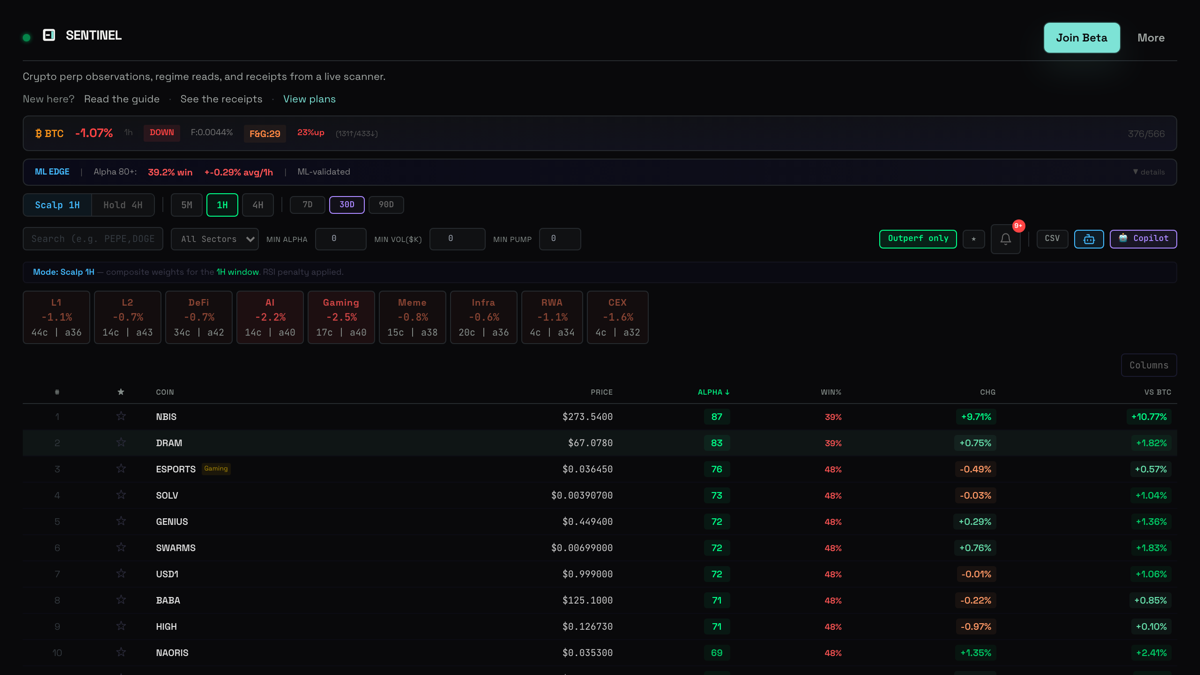
SENTINEL surfaces liquidation pressure as one column inside the broader factor stack alongside momentum, volume ratio, funding, open interest, and the regime gate. The scanner does not treat a single large liquidation dollar amount as a tradeable event by itself. Observations only escalate into a Telegram CORE alert when liquidation pressure agrees with the rest of the factor stack and the regime read.
That is why a SENTINEL subscriber tends to receive fewer "liquidation cascade" alerts than a typical heatmap feed and why each one carries the surrounding factor context. The Telegram crypto scanner guide on the blog walks through what subscribers actually receive on the delivery side, and the Bybit perp scanner factor stack article explains how the columns combine.
The pressure column itself is not just a dollar amount. It tracks the rolling intensity of forced flow over a short window, normalised against recent activity on the same contract, so that a small liquidation on a thin perp can register the same intensity as a larger one on a deeper perp. That normalisation is what keeps the column comparable across the universe instead of always pointing at the largest, deepest contracts.
A short audit checklist for liquidation alert products
Most liquidation alert products are honest about delivery and silent about context. A short checklist filters the noise.
- Does the alert carry funding and open interest context, or only a dollar amount?
- Does the product distinguish between cascade events and isolated liquidations?
- Does it report breadth or regime, or only the symbol that liquidated?
- Does the operator publish receipts of how previous cascades resolved?
- Does the language stay descriptive, or does it tip into "guaranteed bounce" framing?
Three cascade shapes worth recognising
A small number of cascade shapes show up often enough that recognising them in real time is most of the value a scanner can add. The first is the "single big print": one large liquidation that briefly moves price and is immediately absorbed. The shape tends to be a high-leverage position closing into a deep book; it rarely produces a follow-through move because there is no chain of subsequent triggers behind it.
The second is the "stair-step cascade": a sequence of mid-size liquidations spread across several minutes, each one moving price enough to trigger the next batch. This shape is the classic crowded-side unwind. The first leg is often missed because the scanner is still waiting for a single big dollar amount; the stair-step is what most threshold-based products underweight.
The third is the "wick and reclaim": a sharp cascade move that overshoots, prints a long wick, and reclaims the prior range within minutes. This shape is the most expensive to trade because it punishes both the chase and the fade. A scanner that calls it as a cascade in real time without flagging the wick risk is selling certainty it does not have.
- Single big print: usually absorbed; rarely produces follow-through.
- Stair-step cascade: classic crowded-side unwind; often underweighted by threshold alerts.
- Wick and reclaim: overshoots and recovers; punishes both chase and fade.
Receipts before the Telegram trial
SENTINEL publishes a public CORE receipt window on the performance page, fed by https://sentinelresearch.app/api/scanner/tier-performance?mode=live. The receipts cover scanner observations, not liquidation events specifically, but the discipline is the same: published sample size, published losing rows, no curated screenshots.
A trader who is using SENTINEL for the liquidation context should treat the receipt page as the way to audit the broader scanner before paying. Receipts are not promises; they are the inspectable record. Performance language in any SENTINEL surface is qualitative or cites the live endpoint with a UTC timestamp.
Risk boundary
SENTINEL is a research and observation tool. It does not place trades, manage position size, set stops, manage leverage, or offer financial advice. Liquidation events are dramatic and easy to over-trade. Read the full risk disclosure before using the Telegram beta, and never treat forced flow as a guaranteed reversal.
Bybit perpetual futures are leveraged products and can lose more than the margin posted on a single trade. A liquidation alert that arrives without funding, open interest, volume, and regime context is information, not an instruction. The most expensive trades in any leveraged product are the ones taken because an alert sounded loud, not because the surrounding columns agreed.
Common questions
Why do liquidation alerts often mislead in isolation?
A single liquidation print can be a small position closing inside a much larger trend that does not care. A cluster of small liquidations on the short side during a steady uptrend is not the same as a single enormous long liquidation at the high of a range. The difference is the context, not the dollar amount.
What is a liquidation actually on a Bybit perp?
A liquidation happens when a leveraged position no longer has enough margin to cover the move against it. The exchange closes the position at a liquidation price calculated from the maintenance margin, the leverage, and the position's unrealised loss. The closing flow has to find a counterparty in the order book.
What is the difference between a heatmap and a cascade event?
A liquidation heatmap is a visual aggregation of recent forced flow that shows density of past liquidations across price ranges and time — it is not a forecast. A cascade event is a chain of liquidations in close succession, each one moving the price enough to trigger the next.
How do short squeezes and long resets differ?
They can look identical in dollar size on a heatmap. Long resets tend to bottom faster but recover more slowly because regime damage takes time to repair. Short squeezes tend to spike harder and fade faster — the move that triggered the squeeze rarely turns into a sustained trend without a separate catalyst.
What context turns a liquidation alert into something tradeable?
Whether funding was already crowded on the liquidated side before the event, whether open interest was expanding into the cascade or contracting, whether volume supported the move or it was driven entirely by forced flow, and whether the wider market regime is supportive of a rebound or breadth is thin.
What do liquidation alerts miss completely?
Cross-venue context (single-exchange forced flow does not describe the global perp universe), pending stop orders (the order book does not publicly show conditional stops), and slower stair-step cascades that build over twenty or thirty minutes rather than printing as a single big dollar amount.
Try it live
Connect wallet first, then continue with Telegram to unlock trial/Core features.
How this was produced
Every claim was verified against the live SENTINEL codebase and the current product surfaces. This is educational product documentation, not financial advice.