
Reading Open Interest Delta on Bybit: Price-Up-OI-Up and Other Tells
A methodology guide to reading the change in open interest on Bybit perps: what OI delta is, the four ways price and OI can move together, the squeeze and flush setups they point to, and why OI delta is context rather than a signal on its own.
Summary
Open interest delta is the change in the number of open perpetual contracts over a window. Read against the price move, it tells you whether a move is being driven by new positioning, by exits, or by a crowd that is about to be forced out.
This guide explains the four price-versus-OI combinations, the squeeze and flush setups they hint at, the failure modes that make raw OI delta misleading, and why it belongs in a factor stack rather than standing alone.
What open interest delta actually measures
Open interest is the total number of perpetual contracts currently open. Open interest delta is simply how that number changes over a chosen window. Rising open interest means new contracts are being opened, which is fresh positioning entering the market. Falling open interest means contracts are being closed, which is positioning leaving. By itself that number is neutral; its meaning comes almost entirely from what price is doing at the same time.
The useful unit of analysis is therefore the pair: the price move and the open interest delta behind it, read together. The same price candle can be a sign of strength or a sign of exhaustion depending on whether the open interest behind it is building or unwinding. Reading one without the other is how traders end up confidently wrong about who is in control of a move.
The four combinations and what each one hints at
There are four basic ways price and open interest can move together, and each tells a different story about the participants. These are tendencies and starting hypotheses, not certainties.
The reason these matter is that two visually identical moves can have opposite plumbing. A rally on rising open interest and a rally on falling open interest look the same on a bare chart and mean very different things about whether the move has fresh fuel or is just unwinding a crowd.
- Price up, open interest up. New money is opening positions into a rising market. This is the classic picture of fresh participation and is often read as the most genuine kind of strength, because the move is being funded by new positioning rather than by people closing out.
- Price up, open interest down. Price is rising while positions are being closed. This often points to short covering rather than new conviction: a market squeezed higher by people buying back losing shorts, which can be sharp but is being driven by exits, not fresh demand.
- Price down, open interest up. New positions are opening into a falling market, which typically reflects fresh shorting or aggressive new sellers leaning into weakness. A heavily one-sided build like this is exactly the fuel a later squeeze runs on.
- Price down, open interest down. Price is falling while positions close, which usually reads as long liquidation or a flush: leveraged longs being forced or choosing out, with the move powered by exits rather than new conviction.
Where OI delta connects to squeezes and flushes
Open interest delta is most powerful when you combine it with the direction of the crowd it implies. A large one-sided build in open interest is stored energy. When price moves against a crowded side, the same contracts that built the position now have to unwind, and that forced unwinding is the squeeze or the flush. Reading the build in advance is what turns a squeeze from a surprise into a setup you were already watching.
This is also where open interest delta meets funding. Open interest tells you how much positioning has accumulated; funding tells you which side is paying to hold it. A heavy open interest build alongside persistently lopsided funding describes a crowd that is both large and paying for the privilege, which is precisely the configuration that can unwind violently when price turns. Neither field is the whole story; together they describe how crowded and how fragile a move is.
Why OI delta is context, not a signal
Raw open interest delta is easy to over-read, and respecting its failure modes is part of using it well. A change in open interest does not tell you which side opened or closed; the four combinations above are inferences about the likely actor, not confirmations. Open interest can rise simply because hedgers or basis traders are doing their unglamorous work, which has nothing to do with directional conviction. And a single window can mislead: a brief spike in open interest delta around a news event or a funding settlement can look like positioning when it is mostly noise.
For all these reasons, open interest delta belongs inside a factor stack, not on a pedestal. Read alongside price, volume, funding, regime, and breadth, it adds a genuine and hard-to-fake dimension: whether a move is being built or unwound, and whether the crowd behind it is getting more or less crowded. Read alone, it invites exactly the kind of confident, single-factor mistake that a stack exists to prevent.
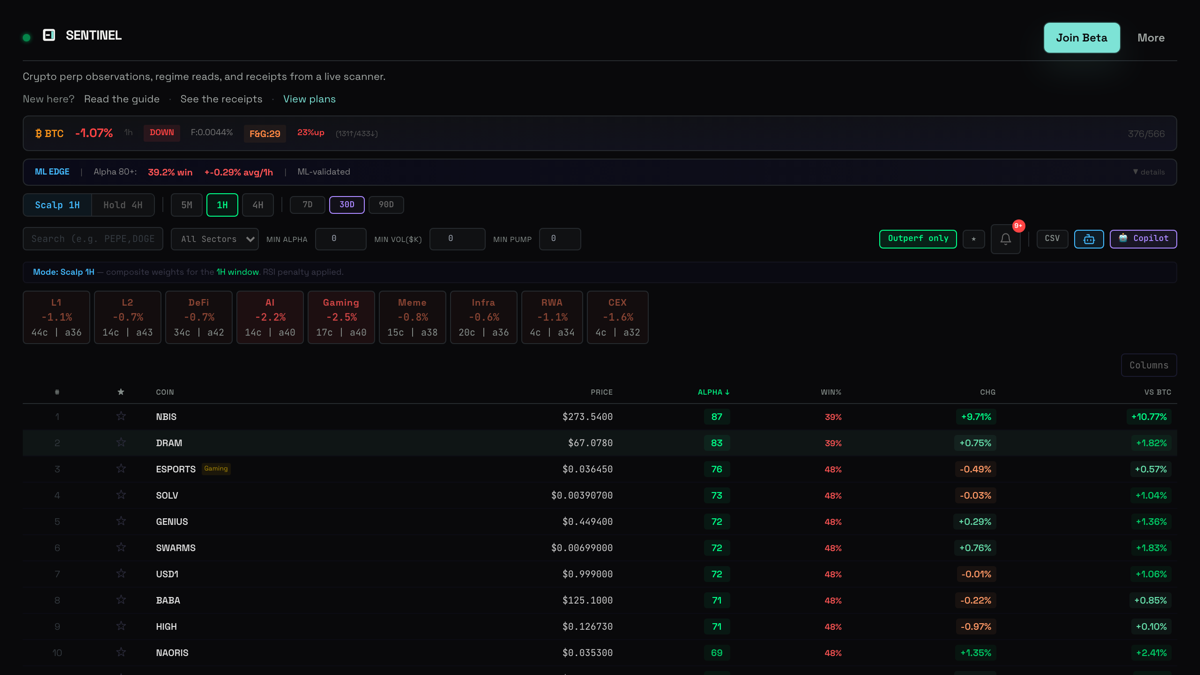
SENTINEL reads open interest delta this way — as one factor among funding, volume, regime, and breadth, scored per Bybit perpetual — and resolved CORE observations land on public receipts, wins and losses on the same page with the sample size shown. That includes red windows when the recent CORE cohort is weak. Open interest delta is a lens for reading the tape, not a promise about where price goes next. Nothing here is financial advice, and a transparent record is not a forecast; it is what lets you check the reading against reality instead of taking it on faith.
Common questions
What is open interest delta on Bybit?
It is the change in the total number of open perpetual contracts over a window. Rising open interest means new positioning is entering; falling open interest means positioning is leaving. On its own it is neutral — its meaning comes from reading it against the price move at the same time.
What does price up with open interest up mean?
It usually means new money is opening positions into a rising market — fresh participation funding the move rather than people closing out. It is often read as the most genuine form of strength, though it is a tendency, not a certainty.
How does open interest delta relate to short squeezes?
A large one-sided build in open interest is stored energy. When price moves against the crowded side, those contracts have to unwind, and that forced unwinding is the squeeze or flush. Reading the build in advance, especially alongside lopsided funding, is what turns a squeeze into a setup rather than a surprise.
Why shouldn't I trade on open interest delta alone?
A change in open interest does not reveal which side opened or closed; it can rise from hedging that has no directional meaning; and a single window can be noise around news or funding settlement. It works best as one factor among price, volume, funding, regime, and breadth, not as a standalone signal.
Try it live
Connect wallet first, then continue with Telegram to unlock trial/Core features.
How this was produced
Every claim was verified against the live SENTINEL codebase and the current product surfaces. This is educational product documentation, not financial advice.