
Crypto Volume Spike Scanner: Separating Real Participation From Thin Pumps
A volume spike alone is not a signal. The factor stack — volume ratio plus open interest delta plus funding plus regime plus spot-perp gap — is what separates real participation from a thin two-sided liquidity event.
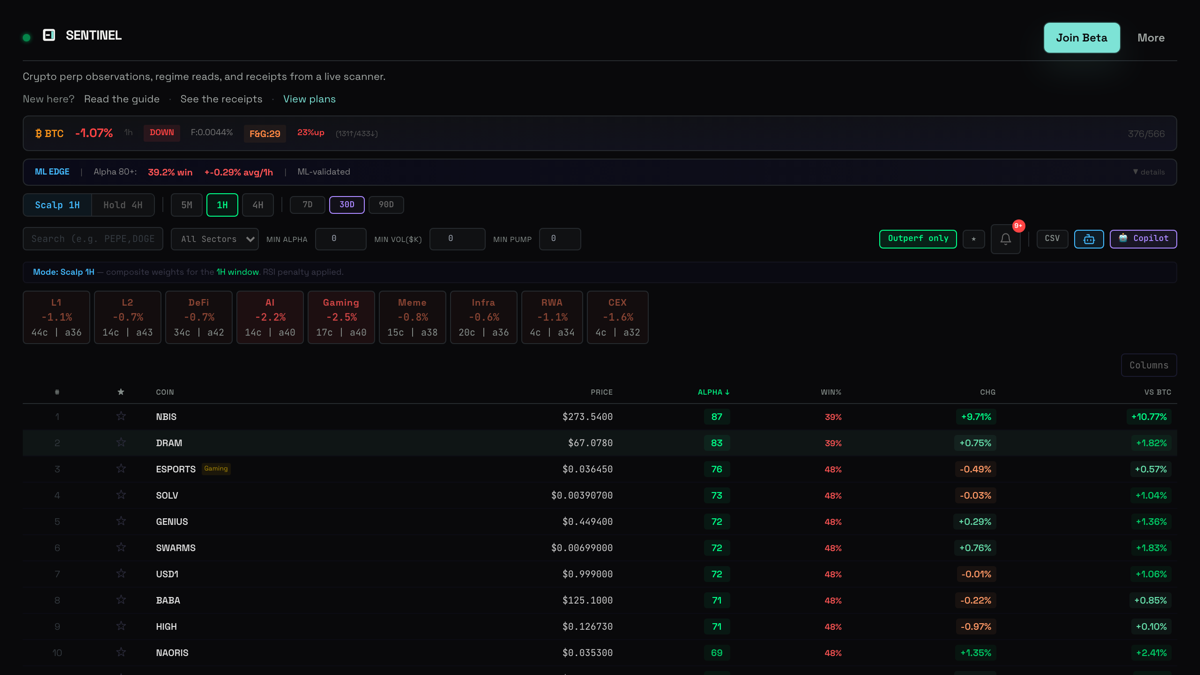
Summary
A crypto volume spike scanner sorts perpetual markets by how far current trading volume sits above its trailing baseline. The output is a ranked list of names where volume just exploded. That ranking, on its own, collapses three different setups — real participation, thin two-sided liquidity, and funding-driven positioning churn — into one bucket. A trader who acts on the list alone is gambling on which of the three this row is.
The factor stack — volume ratio plus open interest delta plus funding plus regime plus spot-perp gap — is what turns a volume row into a read. Volume says something happened; the rest of the stack says what. This piece walks through why volume ratio is not diagnostic on its own, how to read it against open interest, what a thin pump actually looks like, and what to look for in a volume scanner before paying for one.
What a volume spike scanner is supposed to do
A crypto volume spike scanner has a narrow job. It watches the trading volume on each perpetual market, compares the current window to that market's own trailing baseline, and flags every name where the ratio crosses some threshold — usually a multiple like 3x or 5x. The output is a sorted list of perps whose volume just spiked relative to their own recent history.
That sorted list is genuinely useful as a starting point. It compresses an active Bybit perp universe that changes over time down to the ten or twenty names where something is happening right now. A trader who scrolls the full perp board manually misses the small-cap names; a volume scanner does not.
The limit is what the list does not say. A sorted list by volume ratio alone tells you that volume is elevated. It does not tell you whether the move is broad participation, a single whale finding a thin book, a funding-driven unwind, or a forced execution that resolves in three minutes. Acting on rank alone is acting on rank alone — not on a read.
Why volume ratio alone is not diagnostic
Volume on a perpetual market can spike for at least three different reasons, and a scanner that only ranks by volume ratio cannot distinguish between them. The first reason is genuine new participation: price is moving with broad buyer and seller flow, two-sided depth is engaged, and the volume reflects committed capital changing hands. This is the case most traders assume when they see a volume spike.
The second reason is thin two-sided liquidity. On a smaller-cap perp, the order book is shallow enough that a single moderately-sized order — or one liquidation cascade firing through a stop cluster — can produce a volume signature that looks identical to broad participation. The ratio reads the same; the underlying structure is one whale or one forced unwind, not a market.
The third reason is funding-driven positioning churn. A funding period flip can trigger a flurry of position adjustments — shorts closing because the cost-to-carry just turned uneconomic, longs trimming because funding flipped against them — and the resulting volume spike has no committed directional flow behind it. Volume goes up; conviction does not.
A list sorted by volume ratio alone treats these three setups as one. The factor stack is what splits them apart. See the broader walkthrough at /blog/bybit-perp-scanner for how the rest of the stack composes around the volume read.
The factor stack that turns volume into signal
Five factors compose a useful volume read: volume ratio, open interest delta, funding rate, regime label, and the spot-perp gap. Each adds a different slice of information. None of them is diagnostic in isolation; together they describe the structure underneath the candle.
Volume ratio says "something happened" — current activity is materially above this name's own trailing baseline. Open interest delta says whether new positioning was put on or unwound during the same window. Funding says whether the move was leveraged-bid by longs paying to be long, short-covered by shorts buying back, or neutral. Regime says whether the broader tape supports follow-through. Spot-perp gap says whether the cash market validated the move or the perp ran ahead on derivative-only flow.
A row that reads "VR 7x, OI rising, funding ticking positive, regime green-breadth rally, spot tracking" is a different setup from a row that reads "VR 7x, OI flat, funding unchanged, regime thin-breadth down-tape, perp leading spot." The first row has broad participation behind it; the second row is more consistent with a narrow liquidity event. Same volume ratio, opposite read. The walkthrough at /blog/funding-open-interest-scanner covers how funding and open interest interact on the same row.
Reading volume spikes against open interest delta
The single most useful pair on a volume row is volume ratio combined with open interest delta. Volume tells you that flow happened; open interest tells you whether the flow put positions on or took them off. A four-quadrant read — price up or down crossed with OI up or down — covers most of what a volume scanner can actually answer.
When price is up on a volume spike and open interest is also up, new longs are entering the move. The candle is being driven by commitment-bid: traders putting capital at risk in the direction of the move. This is the closest a volume scanner gets to flagging a real breakout in progress, though regime still conditions whether follow-through is plausible.
When price is up on a volume spike but open interest is down, the move is short cover. The candle is being driven by shorts buying back to close, not new longs entering. That is a squeeze setup, and the trade geometry is completely different from a breakout — covered in detail at /blog/bybit-short-squeeze-detector. When price is down with OI up, new shorts are entering; when price is down with OI down, longs are capitulating. Each quadrant has its own follow-through profile.
- VR up + price up + OI up = new longs joining a real move (commitment).
- VR up + price up + OI down = short cover (squeeze setup).
- VR up + price down + OI up = new shorts entering (downside commitment).
- VR up + price down + OI down = long capitulation.
The thin-pump tell
The case a volume spike scanner most often gets wrong is the thin pump. The pattern: a low-cap perp prints a single sharp directional candle, the volume ratio spikes hard, and within minutes price either round-trips back to the pre-spike level or grinds sideways with no follow-through. A naive scanner flags this as a top-of-list candidate; a stack-aware reader sees the tell.
The diagnostic is whether the volume ratio is supported by an open interest change. A real-participation spike puts new positioning on (or takes it off) — open interest moves in proportion to the volume. A thin pump produces a volume signature without a meaningful OI delta, because the trades that filled the volume were largely the same notional changing hands on a shallow book rather than fresh capital committing to a direction.
The other tell is notional size. If the absolute notional volume — not the ratio, the actual dollar size — is small enough that one liquidation or one moderately-sized market order could produce the entire signature, the spike is a single-event print rather than a market read. This often co-occurs with liquidation cascades on thin books; /blog/bybit-liquidation-alerts walks through the cascade signature in detail.
A scanner that does not filter on a minimum notional-volume floor will publish thin pumps as headline rows. A trader who acts on those rows learns the lesson the expensive way.
Regime conditions the read
The same volume row reads differently depending on the broader tape. A volume ratio above 3x on a name during a high-breadth rally — BTC trending up, most perps green, volatility orderly — is far more likely to extend than the identical reading during a thin-breadth down-tape where breadth is below 30% and BTC is leaking. Regime sets the floor for whether follow-through is plausible.
In a chop regime, volume signatures mean-revert faster. A 5x spike that would carry a name for several hours during a trending tape may resolve in 30 minutes during chop, because there is no broader directional bid or offer to absorb the move. The factor stack has not changed; the regime around it has.
A volume scanner that reports the same way across all regimes is missing context. A scanner that publishes the regime label inline lets the trader weight conviction accordingly. The deeper walkthrough on regime composition is at /blog/crypto-regime-read; the short version is that regime is not optional flavor on a row, it is a multiplier on every other factor.
What to look for in a volume scanner before paying for one
Most paid scanner products advertise on the ranked-list output and stop there. The questions a trader should ask before subscribing are about what is computed underneath the ranking and what is published alongside it. Five concrete checks separate a useful tool from a presentation.
First: does the scanner show the full factor stack inline on the row, or only the volume ratio? A scanner that flags a name and forces the trader to go check open interest, funding, and regime on three other tools has not actually compressed the work. Second: does the scanner compute volume against a trailing baseline (rolling window over many candles) or a 24-hour snap denominator? Snap denominators flicker through the day as the rolling 24h window drops old activity and adds new, producing artificial ratio swings that have nothing to do with current flow.
Third: does the scanner publish public receipts that include the volume signals which failed, not only the ones that paid off? A list of winners is curation; a list with both winners and misses is a record. Fourth: does the scanner filter out names below a notional-volume floor, so the thin-book illusion is excluded from the ranked output? Fifth: does the scanner gate by regime, so a 5x signature in a thin-breadth down-tape is weighted differently from the same signature in a green-breadth rally?
The broader cost-vs-value framework is at /blog/free-crypto-scanner-vs-paid-signals; the short version is that the answer to "is this scanner worth paying for" turns on whether it publishes the misses honestly and computes its inputs against stable baselines.
How SENTINEL handles volume
SENTINEL computes the volume ratio against a rolling baseline rather than a 24-hour snap denominator, so the ratio does not flicker as the window edges roll. The same rolling window is used for the open interest delta, which keeps the two factors directly comparable on a row. Funding rate level and direction of change, regime label, and the spot-perp gap compose the rest of the stack.
A minimum notional-volume floor filters out names where a single small order can swing the ratio. The volume read is one factor among several in the alert score — it never carries an alert on its own. The CORE-tier rolling track lives on /performance, including the volume-led observations that did not follow through; the misses are part of the record, not removed from it.
The hosted SENTINEL Trend Pine script is free and open-source for chart-side trend context. The Telegram beta is where SENTINEL delivers the full factor read inline on each observation rather than the bare volume ratio.
Risk boundary
A volume spike scanner reduces information asymmetry. It compresses the active perp universe down to the rows where flow is currently elevated, and a stack-aware reader can split those rows into real participation, thin two-sided liquidity, and positioning churn. That is observation. It is not prediction.
Real-participation reads still fail. Thin-pump reads still sometimes extend further than the structure suggests they should. The factor stack improves the odds of reading a row correctly; it does not eliminate the cases where the read is wrong. Research only. Not financial advice. Read the public receipts before trusting any tool that claims to flag volume signals — including this one — and read the risk disclosure before using the Telegram beta.
Try it live
Connect wallet first, then continue with Telegram to unlock trial/Core features.
How this was produced
Every claim was verified against the live SENTINEL codebase and the current product surfaces. This is educational product documentation, not financial advice.