
Best Crypto Scanner With Telegram Alerts: Audit Checklist Before You Pay
A practical audit checklist for paid Telegram crypto scanners. Receipts, factor stack, regime context, trial mechanics, refund clarity — the questions to answer before any subscription, with worked criteria.
Summary
"Best" is a marketing word. A trader paying for a Telegram crypto scanner is buying a process, not a brand. The audit questions are the same whether the service costs $20 or $200: are the receipts public, is the factor stack disclosed, does regime gate the alerts, and is there a refund path if the workflow does not fit?
An honest checklist takes twenty minutes and prevents the most common buyer regret in this category — subscribing to a stream of green-candle pings and discovering the receipts surface is either curated or absent. The same checklist applies to free signal groups, which carry their own incentive problems even when nothing changes hands.
Why "best" is the wrong question
A trader searching for the "best crypto scanner with Telegram alerts" is usually looking for the wrong artifact. There is no single best — there is the scanner whose process matches the trader's playbook, whose receipts the trader can inspect, and whose risk boundary the trader trusts. Switching from "which one is best" to "which one passes my audit" is the move that prevents most buyer regret in this category.
The audit is the same whether the service costs twenty dollars or two hundred. A paid subscription is a recurring expense; treating it as a one-click impulse purchase is how traders end up paying for streams of green-candle pings without discovering whether the receipts surface is real, curated, or absent. A twenty-minute pass through a fixed checklist before the first payment is the cheapest insurance available against the most common failure modes.
The checklist below assumes a Bybit perpetuals trader, but the questions apply to any exchange-focused signal product on Telegram. The format matters because Telegram is the channel, not the product. The product is the scanning process upstream of the message. A beautiful Telegram template attached to a worthless scanner is a worse product than an ugly Telegram template attached to a competent one.
Receipts: published track record vs marketing constants
The first audit question is whether the scanner publishes its receipts. A receipt feed is a rolling, public record of the observations the scanner has flagged, including the ones that did not work out. Marketing constants — "we hit 72 percent win rate" on the landing page — are not receipts. They are claims. A claim without a verifiable trace is just a claim, and stale claims in this category are everywhere.
A real receipt feed has four properties. It updates on a rolling window so the most recent observations are visible without contacting support. It includes both winners and losers; a feed that only publishes winners is curated, not measured. It carries timestamps so a trader can reconcile the receipt with their own data. And it cites the same parameters across rows, so the reader is not comparing a thirty-minute hold to a four-hour hold without knowing the difference.
The receipt feed test is binary. Either the scanner has a public, rolling feed of observations with both winners and losers, or it does not. If a scanner advertises a percentage win rate but cannot produce the underlying receipts, the percentage is a marketing artifact regardless of whether the math behind it is honest. A trader subscribing without seeing the receipt feed is paying for the brand of confidence, not the substance.
- Rolling time window with at least the last thirty days visible.
- Both winners and losers, not curated highlight reels.
- Timestamps so the reader can cross-check independently.
- Same hold-window assumptions across every row.
The factor stack: what actually drives the alert
The second audit question is whether the factor stack is disclosed. A factor stack is the set of inputs the scanner uses to generate an alert: price action, momentum scores, volume ratio against a baseline, funding rate, open interest delta, market regime label. A scanner that publishes its factor stack is telling the trader what to expect; a scanner that hides it is selling a black box.
Hidden factor stacks are not always a deal-breaker, but they shift the entire weight of the audit onto the receipt feed. If the trader cannot inspect what drove the alert, the only test of the system is whether the published receipts match the marketing claims over time. That is a slower, more expensive audit, and it requires waiting through multiple regimes before any signal-vs-noise read is possible.
A disclosed factor stack lets the trader compare the scanner's output to their own read. If the trader independently believes funding rate plus open interest delta plus volume ratio is the right minimum stack for Bybit perps, a scanner that publishes those three factors inline with every alert is more credible than a scanner that publishes only a name and a score. The trader can sanity-check each alert against the chart in under a minute, which is the audit pace this category needs.
- Are the inputs named (funding, OI, volume, momentum, regime)?
- Are the values published inline with each alert?
- Is the scoring or ranking method described, even at a high level?
- Are the cadence and update frequency explicit?
Coverage and universe: what symbols, what exchange
The third audit question is what the scanner actually covers. A "crypto scanner" can mean the top hundred coins by market cap, all USDT-perp pairs on a single exchange, or an opaque hand-curated list that the operator narrows down each week. The coverage question matters because a scanner restricted to BTC, ETH, and the top fifteen alts will not see the same opportunities as a scanner that runs over the full perp universe on Bybit or Binance.
Coverage breadth has trade-offs. A wider universe surfaces more setups, but it also dilutes attention and increases the risk that the trader chases thin-book names without realizing it. A narrower universe filters by liquidity and quality but misses the early-stage alt moves that often produce the largest single-trade asymmetry. Neither is wrong; the trader needs to know which one they are paying for before they pay for it.
A scanner that does not publish its universe is forcing the trader to infer it from the alert feed. That is doable over a few weeks of observation, but it is also a form of opacity that protects the operator from accountability — a scanner that only flags BTC and ETH in a quiet tape and then conveniently catches the latest meme runner can claim to "cover the market" without anyone being able to check.
Regime gating: does the scanner adapt to BTC and breadth
The fourth audit question is whether the scanner gates by regime. A regime gate is a check that suppresses or amplifies alerts based on the wider market state — BTC trend, market breadth (the proportion of perps green over a window), volatility level, dominance shifts. A scanner without a regime gate fires the same alerts in a breadth-supported rally as it does in a thin-tape chop, which is one of the most reliable ways to produce false positives.
A regime-aware scanner publishes its regime label inline with the alert. The label might be a compact phrase ("low breadth, BTC weak"), a numeric breadth percentage, or a categorical state (risk-on / mixed / risk-off). The format matters less than the presence of the label; what matters is that the trader can see at a glance whether the broader tape is supporting the named setup.
A scanner that fires identical-looking alerts regardless of regime is publishing observations without context. The same volume spike in a strong rally and a quiet down-tape do not deserve the same trust, and a scanner that treats them as equivalent is offloading the regime read onto the trader after the alert has already triggered the urge to act. Front-loading the regime context is the difference between a research surface and a notification stream.
- Is there a published regime label on every alert?
- Does the scanner suppress alerts in hostile regime conditions?
- Are BTC trend, breadth, and volatility part of the gate?
- Does the gate ever explain why a coin was filtered (suppression reasons)?
Telegram delivery quality
The fifth audit question is about the Telegram surface itself. Telegram is a fast channel, but it is also a noisy one. A scanner whose alerts arrive as walls of unformatted text, with no clear hierarchy between the symbol, the score, the factor read, and the action note, trains the trader to skim past the message. A scanner whose alerts are formatted with clear sections, premium styling, and inline links to the underlying receipts gets read.
The mechanics matter too. Are the alerts sent with rate limits that prevent flooding during fast tapes? Does the bot recover gracefully from polling errors and resume without subscriber intervention? Are admin messages and subscriber messages cleanly separated, so the subscriber surface is never polluted with operator debug output? These details are not glamorous, but they are the difference between a Telegram product a trader keeps and one they mute within a week.
A scanner with a /coach, /performance, or equivalent self-service command set inside Telegram lets the trader inspect the system without leaving the channel. A scanner that requires a separate web login to see receipts or change settings introduces friction that subscribers will avoid. A clean Telegram product treats the channel as the primary surface, not as a notification shim glued onto a web dashboard.
Trial mechanics and cancellation friction
The sixth audit question is whether there is a real trial. A real trial means a meaningful subset of the production stream — not a tutorial, not a recap, not a teaser — available for a fixed window without payment commitment. A trial that requires payment up front with a refund window is not a trial; it is a refund. The distinction matters because the trader's friction profile is different in each.
A useful trial lasts long enough to span at least one regime shift. A two-day trial in a quiet weekend tape teaches a trader nothing about how the scanner behaves in a Monday open. A fourteen-day trial spans both kinds of conditions and produces enough observations that the trader can run their own informal review of the receipt feed against the alerts they actually received. Anything shorter is sales theater.
Cancellation friction is the mirror image of trial mechanics. A subscription that requires emailing support to cancel is rigged against the user; a one-click cancel from inside Telegram or a subscriber dashboard is respectful. The cancel path is itself a signal — if the operator makes cancellation hard, the operator does not trust the product to retain on its own merits, which is the strongest tell a trader can read short of the receipt feed.
- Is the trial accessible without entering payment details?
- Does the trial deliver the same alerts production subscribers receive?
- Is the trial long enough to span more than one regime?
- Is cancellation one-click and self-service?
Refund and access-period clarity
The seventh audit question is the boundary between trial and paid access. A paid subscription should publish its access window in plain text — fourteen days, thirty days, monthly recurring — and the refund policy should be explicit. A page that buries the refund terms in a footer link is signaling that refunds will be friction-laden. A page that publishes the refund window and the criteria up front is signaling confidence in the product.
Pro-rated refunds, partial-month refunds, and prorated access on cancellation are all rare in crypto signal subscriptions. That is not by itself a deal-breaker — most software subscriptions work the same way — but the trader should know which model applies before paying. The bad case is the subscription that quietly auto-renews at a different rate than the advertised entry price; a scanner that does this is not selling a tool, it is selling a renewal trap.
The terms link on the landing page should answer the access-period question before payment, not after. A scanner that requires a support ticket to clarify "how long does this subscription last and what happens if I cancel halfway through" is a scanner that does not want the answer to be a one-line read. The audit answer is binary again: either the terms are plain text, public, and one-click accessible, or they are not.
Risk boundary disclosure
The eighth audit question is whether the scanner publishes a risk boundary. A risk boundary is the explicit statement that the scanner produces observations rather than instructions, that the published receipts include losers, that crypto perpetual futures are leveraged products which can lose more than the position size, and that no signal is a guarantee. A scanner without a risk boundary is either careless or hiding something.
The risk boundary should be visible from the landing page and from the Telegram welcome message, not buried in a separate terms of service that the user is unlikely to read. The point is not legal cover; the point is to set subscriber expectations correctly before they receive their first alert. A subscriber who understood the risk boundary in advance is less likely to over-size a single trade and blame the scanner for the outcome.
Honest risk boundaries are often dry. They will say things like "the receipts above describe past observations, not future performance" and "any signal can fail; the published track record includes failed observations alongside successful ones." That dryness is a feature, not a bug. A scanner that markets itself with no risk language at all is either trying to attract users who will read the silence as a promise, or assumes the legal terms cover the same ground in fine print. Neither is reassuring.
How SENTINEL answers these questions
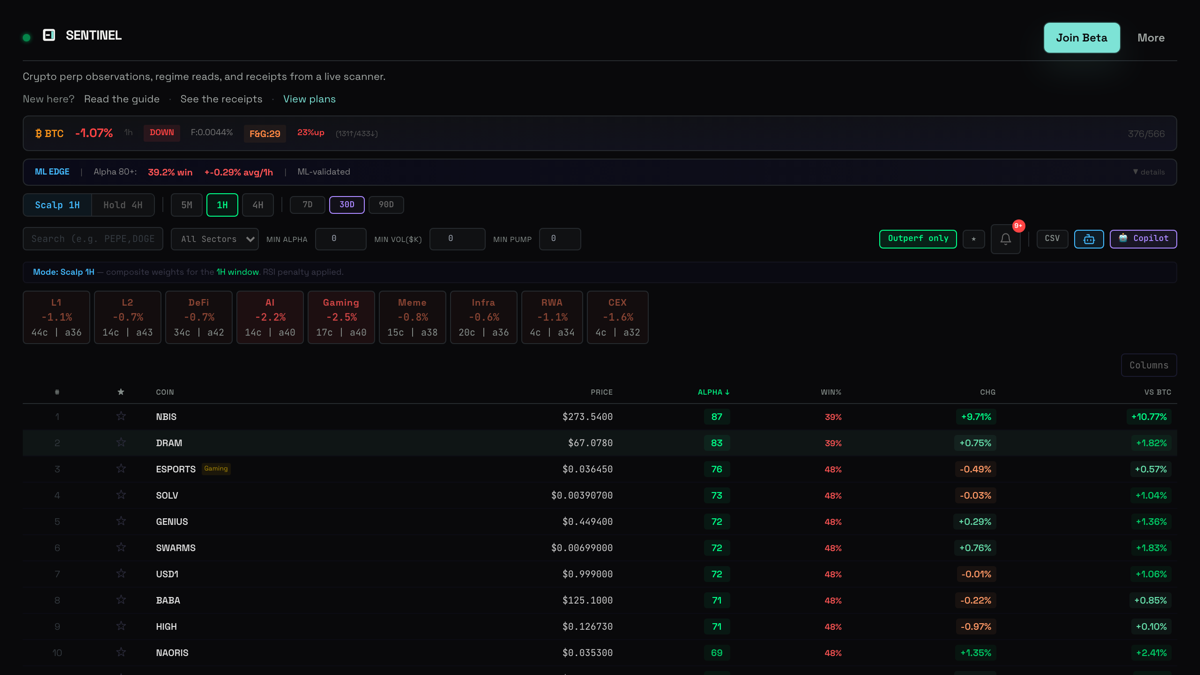
SENTINEL is a Bybit-perp-focused research desk built around the audit answers a paid subscriber would expect. The receipt surface is public at /performance and rolls forward continuously, including the resolved observations that failed to follow through. The factor stack is published inline with eligible CORE alerts: funding rate, open interest delta, volume ratio against a trailing baseline, momentum scores, and a market-wide regime label. Coverage follows the active eligible Bybit USDT-perp universe with thin-book filtering by minimum notional.
The regime gate is wired in at the scanner level. Each observation carries a regime label built from BTC move, breadth, and volatility, and observations are suppressed when the regime is hostile rather than fired into the noise. The Telegram surface uses premium HTML formatting with consistent sections per alert, inline links to the receipt feed, and self-service commands for /coach, /performance, and subscription state. The fourteen-day trial spans more than one regime by design rather than by accident.
The free SENTINEL Trend Pine script is hosted openly with the source visible. That keeps the chart-side trend reference transparent while the server-side factor stack, regime gate, and internal model diagnostics stay in the scanner. The audit checklist above is the same checklist SENTINEL was built against, not a sales prop.
Common audit mistakes
The most common audit mistake is anchoring on the marketing percentage without ever opening the receipt feed. A percentage on a landing page is a hypothesis; a rolling feed is the evidence. Subscribing to a service whose receipt feed the trader has not personally browsed is buying a brand of confidence, not a product. Twenty minutes of receipt-feed reading prevents weeks of subscription regret.
A second common mistake is overweighting the trial experience. A two-day window in a quiet weekend tape teaches the trader nothing about how the scanner behaves in a fast Monday open. The trial is the smallest evidence point, not the largest; the receipt feed and the factor disclosure carry more weight precisely because they span regimes the trial may not see. A scanner that looks underwhelming in a quiet trial may be sharper than expected in an active tape, and vice versa.
The third common mistake is treating the audit as a one-shot pre-payment exercise. The receipt feed should be re-checked monthly during the subscription, not just before the first payment. A scanner whose receipts drift in quality over time is signaling either changing market conditions the scanner is not adapting to, or operator attention drifting elsewhere. The audit is cheaper to renew than the subscription is to refund.
- Read the receipt feed for at least ten observations, including losers.
- Reconcile two or three published alerts against your own chart data.
- Confirm the trial window covers more than one tape state.
- Re-audit monthly; the answer can change.
Risk boundary
A pre-payment audit reduces the probability of subscribing to a misaligned scanner. It does not eliminate the risk that the underlying market changes faster than the scanner can adapt, that a particular regime exposes a weakness the receipt feed did not show, or that a personal trading style is mismatched even with a high-quality product. The audit is a filter, not a guarantee.
Bybit perpetual futures are leveraged products. A scanner subscription does not change the risk profile of the instrument; if anything, it can amplify it by reducing the trader's intrinsic hesitation about taking a setup. Treat any scanner — including SENTINEL — as a research surface that publishes observations, not a system that issues instructions. Read the public receipts before paying. Read the risk disclosure before using any Telegram beta. And never let an alert system define position size or stop placement.
Try it live
Connect wallet first, then continue with Telegram to unlock trial/Core features.
How this was produced
Every claim was verified against the live SENTINEL codebase and the current product surfaces. This is educational product documentation, not financial advice.