
Free Crypto Scanner vs Paid Signals: Where Receipts Actually Live
A clear comparison of free crypto scanners and paid signal services, what each format actually delivers, and how to audit either one before paying.
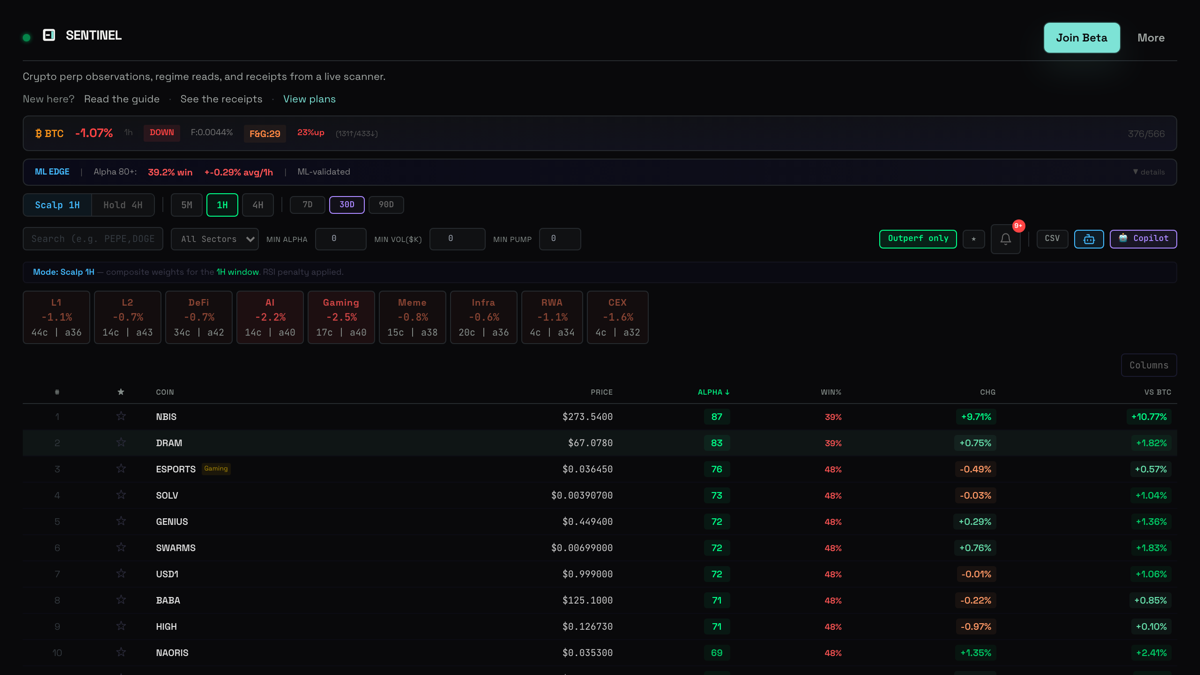
Summary
A free crypto scanner and a paid signal service answer different questions. A scanner shows the tape; a signal service hands a trader a packaged opinion. Neither format is automatically better; what matters is whether the product is honest about what it knows, what it does not know, and what happened the last time it was wrong.
SENTINEL sits between those formats: a public scanner anyone can read, a free CORE receipt window, and a paid Telegram beta where the factor stack and regime context arrive without the trader having to maintain their own infrastructure.
The buyer's question behind the search
The phrase "free crypto scanner vs paid signals" usually means a trader is sitting in front of three browser tabs. One is a free scanner that surfaces the daily movers but does not explain very much. Another is a paid Telegram channel promising filtered alerts. The third is a chart they have been trying to manage themselves. The question they are actually asking is not which format wins; it is which one earns the next hour of their attention.
Most comparisons online answer with a price tag. That is the least useful axis. The right axis is the one a serious trader applies to any tool: what does it actually claim, what data does it stand on, and how does the operator behave when the claim is wrong? That question cuts through "free vs paid" much faster than a feature checklist.
A buyer who already knows the question they want to answer has a much easier time choosing. A buyer who treats the search as "find me the magic edge" tends to end up paying for whichever channel had the loudest recent screenshot. The framing in this article is built for the first buyer, not the second.
What "free" actually means in crypto scanners
A free crypto scanner is usually a thin layer on top of public exchange data. It pulls candles and 24h gain, maybe a funding number, maybe an open interest delta, and sorts the universe by a single column. That format is useful as a starting point. It is honest about its job: surface the universe, let the trader look.
The trap with free scanners is that the surface is shallow. A column for funding does not become useful until it is read against open interest, volume, and regime. A 24h gain column does not become useful until it is qualified by where the move started. Most free scanners do not stitch that context together because that is where the engineering cost lives. They are a discovery tool, not a decision tool, and reading them as if they were a decision tool is how green candles turn into late entries.
The crypto perp scanner overview on the blog walks through what a scanner should actually surface beyond a single ranked column, and where the work has to happen for the scanner to be useful at decision time rather than just at discovery time.
What "paid signals" usually delivers
A paid signal service usually packages a ticker, a direction, sometimes a price level, and a confidence note. The promise is that someone else has already done the filtering. In practice, the quality range is enormous. The strongest services are run by traders with a clear process and a public record. The weakest are screenshots of winners selected after the fact, recurring billing, and a Telegram channel that quietly resets when the streak ends.
The cost is not the price. The cost is the time spent acting on alerts that were never accountable. A paid signal that fires without context is harder to evaluate than a free scanner row, because the trader is renting an opinion rather than reading the data themselves. When the opinion is wrong, there is often no surface to inspect.
A paid service that is worth its fee tends to look more like a research subscription than a signal channel. It publishes its process, its sample size, and its losing rows alongside its winners. It treats the subscriber as a peer who is going to audit the work, not as an audience for a daily highlight reel.
- Selected screenshots are not a record.
- A win rate without sample size and timeframe is not measurable.
- A signal without factor context is harder to debug than the raw scanner row would have been.
- Recurring billing with no inspectable receipts is a marketing arrangement, not a trading arrangement.
The hidden cost of free: time and noise
A free scanner does not actually cost zero. It costs the time a trader spends building their own context layer around the columns the scanner does provide. For a serious perp trader, that context layer (funding, open interest, breadth, regime, volume) is a substantial second job. The free scanner is honest about what it surfaces; the trader is then on the hook to assemble the rest.
The other hidden cost is noise. A free scanner that fires on every threshold cross teaches the trader to act on shallow reads. Over months, that habit calcifies. A trader who is used to acting on a single ranked column rarely transitions cleanly to a workflow that requires waiting for multiple columns to agree.
The hidden cost of paid: opacity and renewal
A paid signal service has its own hidden cost, and it is not the monthly fee. It is the opacity of the process behind the signals and the inertia of the recurring billing relationship. Once a trader is paying for a channel, they tend to stay paying past the point where the channel still earns its fee, because cancelling feels like admitting the experiment failed.
A subscription that auto-renews every month is also a subscription the operator does not have to re-earn every month. That is a perverse incentive. The strongest paid services either keep the renewal cycle short or, better, make the trader take an explicit action to continue. The structural detail matters more than most buyers think it does.
Receipts are the discriminator
The cleanest test for either format is whether the operator publishes receipts a trader can read before paying. A receipt is not a screenshot. It is a closed-window record that includes the sample size, the wins, the losses, and the worst row inside the current measurement window. It is harder to fake than a curated thread because the format forces the operator to keep the misses visible.
SENTINEL publishes a public CORE receipt surface on the performance page, fed by https://sentinelresearch.app/api/scanner/tier-performance?mode=live. The numbers are qualitative until the trader inspects them at the timestamp they care about, because crypto perps move fast and a number quoted in a blog post is already stale by the time it is read. The point is not to argue any specific figure; it is to keep the format inspectable.
The receipt page is meant to be read before the Telegram trial, not after. A trader who joins the trial without first inspecting the receipt page has already skipped the part of the workflow that lets them disagree with the operator.
How to audit a paid signal service before paying
A short audit catches most weak services in under fifteen minutes. The list is short because it does not try to grade the operator's strategy; it grades the operator's honesty. Apply it to SENTINEL too, because the same checklist is the reason this article exists.
- Is there a published record with sample size and losing rows, not just winners?
- Does each signal include factor context, or only a ticker and a direction?
- Does the service avoid "guaranteed", "100x", and target/stop language as if they were facts?
- Is renewal clear before payment, with no auto-charging surprises?
- Does the operator have a public surface a trader can read without joining the paid channel first?
- When the service was wrong, did the operator acknowledge it on the same surface?
Where SENTINEL sits in the matrix
SENTINEL is built to occupy the part of the map most comparison articles skip. The free side is the public scanner anyone can read without an account, plus the public CORE receipt page, plus the scanner field guide in the docs. The paid side is the Telegram beta, where the same factor stack arrives with regime context, weekly receipts, and the account workflow attached. The split is intentional: the website is for inspection, the bot is for delivery.
A trader can spend as much time as they want on the free side before deciding whether the 14-day CORE access is worth it. The Telegram crypto scanner guide on the blog explains what subscribers actually receive, and the Bybit perp scanner factor stack article explains how each column is read.
The trial as honest evaluation
A trial is only useful if it gives a trader enough live context to judge the workflow. A trial that fills the channel with marketing messages is not an evaluation window. SENTINEL's 14-day CORE access is the same LIVE CORE observation stream a paying CORE subscriber receives, with no special "trial-only" content, because the only honest way to evaluate a delivery surface is to use it the same way a paying subscriber would.
Payments are one-off USDC renewals through Solana Pay. The product does not store card details or auto-renew access. That posture is a feature, not a concession: it means the trader's decision is renewed every cycle on their own initiative, instead of a quiet recurring charge that nobody audits.
Free scanner, paid bot: not a contradiction
The two formats are most useful in combination, not in opposition. A free scanner gives a trader the universe and lets them practise reading the tape. A paid Telegram delivery surface gives them filtered observations with factor and regime context attached. The trader who can do both reads the public scanner during research time and watches Telegram for live observations during market hours.
The right answer to "free scanner vs paid signals" is rarely either-or. It is usually "use a free scanner you trust, and a paid surface only when the operator publishes inspectable receipts". Anything else is renting opinions.
Common patterns in weak paid services
A handful of patterns show up repeatedly in weak paid signal services, and naming them is the cheapest way to avoid the worst of them. The first is the "streak channel": a Telegram or Discord that posts winners aggressively, hides losers, and quietly reopens under a new name when the streak breaks. The historical record is missing because the historical record would tell the story the operator does not want to tell.
The second is the "leverage farm": a channel that pushes high-leverage entries on every signal, often with a recommended position size attached. The math works for the operator (affiliate revenue or fee per fill) and against the subscriber (one bad signal at 20x leverage wipes weeks of fees). A serious paid product almost never tells the subscriber how much to risk; that is the trader's job, and conflating the two is a bright red flag.
The third is the "tier ladder": a free channel that exists to upsell into a higher-priced tier, then another higher-priced tier, with the promise that the "real" signals live further up. Most of the time the higher tiers are the same data with extra urgency around it. The structure is designed to maximise the average revenue per subscriber, not to maximise the subscriber's read of the market.
- Streak channels: aggressive winners, missing losers, mysterious history.
- Leverage farms: position-size recommendations, high-leverage entries, affiliate incentives.
- Tier ladders: free → mid → premium, with the "real" data always one tier away.
- Any service that gets defensive when asked about its sample size or losing rows.
What changes when you treat scanner data like inventory
A useful frame for the free-vs-paid question is to treat scanner data like inventory in a kitchen rather than a recipe. The free scanner is the produce aisle: it shows what is in season today, and a trader who knows how to cook can build a meal from it. The paid Telegram surface is closer to a curated produce box: someone else has filtered out the bruised items and added the herbs that complement the main ingredient. Neither replaces the trader's judgement at the stove.
The kitchen analogy makes the trade-off explicit. A buyer who wants raw inventory and is happy to assemble the dish themselves should lean free. A buyer who wants the inventory pre-filtered and contextualised is paying for the filtering. Buyers who expect the paid service to also cook the meal are setting themselves up to be disappointed, and that disappointment is the source of most "this product is not what I thought" reviews.
Risk boundary
SENTINEL is a research and observation tool. It does not place trades, manage position size, set stops, manage leverage, or offer financial advice. Crypto perpetual futures are leveraged products and can lose more than the margin posted on a single trade. Free or paid, no scanner removes the need for the trader's own risk limits.
Read the risk disclosure before using the Telegram beta, and treat every observation as information that needs to be checked against the trader's own process before any action. A signal service that promises to remove risk is selling a story; a scanner that admits risk is part of the workflow is doing its job.
Common questions
What is the real question behind "free crypto scanner vs paid signals"?
Not which format wins on price, but which one earns the next hour of your attention. The right axis is what the product actually claims, what data it stands on, and how the operator behaves when the claim is wrong.
What does "free" actually deliver in a crypto scanner?
A free crypto scanner is usually a thin layer on top of public exchange data — candles, 24h gain, maybe a funding number, maybe an open interest delta — sorted by a single column. It is a discovery tool, not a decision tool, and reading it as a decision tool is how green candles turn into late entries.
What do paid signal services usually package?
A paid signal service usually packages a ticker, a direction, sometimes a price level, and a confidence note. The quality range is enormous — the strongest are run by traders with a clear process and a public record; the weakest are selected screenshots and recurring billing.
Why are receipts the cleanest test of either format?
A receipt is a closed-window record that includes the sample size, the wins, the losses, and the worst row inside the current measurement window. It is harder to fake than a curated thread because the format forces the operator to keep the misses visible.
How do I audit a paid signal service before paying?
Check for a published record with sample size and losing rows, factor context per signal, absence of "guaranteed"/"100x"/target/stop language as if they were facts, clear renewal terms with no auto-charging surprises, a public surface readable without joining the paid channel, and operator acknowledgment of past misses on the same surface.
What are the most common weak-paid-service patterns?
The "streak channel" (aggressive winners, hidden losers, mysterious history), the "leverage farm" (position-size recommendations, high-leverage entries, affiliate incentives), and the "tier ladder" (free → mid → premium, with the "real" data always one tier away).
Try it live
Connect wallet first, then continue with Telegram to unlock trial/Core features.
How this was produced
Every claim was verified against the live SENTINEL codebase and the current product surfaces. This is educational product documentation, not financial advice.