
How to Verify a Crypto Signal Service Before You Pay
A buyer’s checklist for crypto signal groups: how to tell a real track record from a screenshot, why losing trades and sample size matter, and the one question that filters most scams.
Summary
Most crypto signal services show you a wall of winning screenshots and never the losses. That is a marketing deck, not a track record.
This is a short, vendor-neutral checklist for verifying any signal service before you pay, built around one question: will they publish their losing trades, with sample size, next to the wins?
Why most crypto signal services fail the basic test
The crypto signal market runs on selection. A vendor posts the trades that worked, crops the timestamp, and lets the green candles do the selling. You never see the trades that hit a stop, the weeks that bled, or how many signals it took to produce the handful you are looking at. By the time you have paid, the only record you can inspect is the one they chose to show you.
Verification is the act of removing that selection. You are not trying to judge whether a single screenshot is real. You are trying to see the whole distribution: wins and losses, the sample size behind them, and whether the number is live or frozen. A service that makes that easy is rare. A service that makes it hard is telling you something.
The one question that filters most scams
Ask to see the losing trades. Not a disclaimer that losses can happen, but the actual losing rows, shown at the same weight as the winners, on the same page, for a window you did not get to pick.
This question works because it is cheap for an honest vendor and expensive for a dishonest one. A service that already publishes its full resolved record can answer in one link. A service built on cherry-picked wins has to either refuse, stall, or fabricate, and all three are answers. The worst week is the proof the receipts are real.
A six-point verification checklist
You can run this in a few minutes before you spend anything. None of it requires trusting the vendor; it only requires that they let you look.
- Receipts, not screenshots. Is there a live page of resolved outcomes you can open yourself, or only images the vendor pasted into a channel?
- Losses shown at equal weight. Are losing trades visible next to the winners, or is the feed all green?
- Sample size stated. Ten wins out of ten trades and ten wins out of two hundred are very different claims. Is the count shown?
- A closed window you did not choose. Does the record cover a fixed recent period, or a hand-picked range that ends on a good day?
- A falsifiable method. Is there a written process you could disagree with, or just confidence and emojis?
- Honest disclosure. Does the service acknowledge thin samples, weak windows, and that none of it is financial advice?
Receipts beat screenshots because they cannot be curated
A screenshot is a claim about the past, edited by the person making the claim. A live receipt page is a claim that updates whether the vendor likes the result or not. The difference is not cosmetic. It is the difference between a record you audit and a record you are asked to trust.
When performance is published live, a weak month shows up as a weak month. That is uncomfortable for the vendor and useful for you, because it means the good months were not edited either. If a service only ever shows you a static image, assume the live number would look worse, because if it looked better they would show it.
Sample size and survivorship: why a handful of wins means nothing
Crypto perps are noisy. Over a short enough window, a coin flip produces streaks that look like skill. A vendor showing five or ten winners has shown you almost nothing, because the same five or ten could be drawn from a process with no edge at all. Worse, the services you hear about are the ones that happened to run hot, which is survivorship: the failures went quiet and the lucky ones bought ads.
This is why sample size and the full record matter more than the highlight reel. A break-even or losing window shown openly, with a real count behind it, is more trustworthy than a perfect record with no sample, because you can see what you are actually buying instead of what survived.
How to actually read a receipt page
A live receipt page is only useful if you know what to look at, and most buyers do not, which lets weak pages pass as strong ones. Start with the denominator. A record of resolved outcomes should tell you how many observations sit behind it, because a high hit-rate over a handful of trades and the same hit-rate over a large sample are completely different claims about edge. Then find the worst row and read it on purpose. A page that surfaces its largest loss and weakest window is exposing the information a marketing deck is built to hide, and a page that has no visible worst row is usually a curated subset wearing the costume of a ledger.
Next, check whether the window moves. A genuine receipt feed advances as new observations resolve, so a weak stretch eventually appears whether the vendor likes it or not; a frozen screenshot is fixed at a flattering moment by definition. Finally, separate the transparency of the page from the performance on it — these are two independent judgments and conflating them is the most common buyer error. A page can be admirably transparent and still show a result you would not pay for. SENTINEL's own /performance page is the working example: it separates resolved CORE receipt rows from route-simulation evidence, shows the sample size and the worst row, and is allowed to look bad when the recent CORE window is weak.
- Read the denominator first — the sample size behind the record decides what the rate even means.
- Find the worst row and the weakest window on purpose; their absence is itself a finding.
- Confirm the window advances as outcomes resolve, rather than being frozen at a flattering date.
- Judge transparency and performance separately — a page can be honest and still show a result you would skip.
What verification does NOT prove
Verification is a floor, not a guarantee, and it is worth saying so before anyone reads a clean receipt page as a green light. Confirming that a service publishes its losses, its sample size, and a live window proves that the record is auditable — it does not prove the service will be profitable for you, that a past window predicts the next one, or that an honest method is a good method. Crypto perps are noisy enough that even a transparent, well-constructed process can sit in a losing window, which is exactly the situation the checklist is designed to let you see rather than hide.
So the checklist filters out the dishonest, not the merely difficult. It removes the vendors who cannot or will not show you the whole distribution, which is most of the market. It does not remove market risk, replace position sizing, or substitute for your own judgment about whether a method's logic makes sense to you. A verified record raises the floor of your decision from "trust the screenshots" to "audit the ledger," and that is the entire claim. None of this is financial advice, and a transparent record is a tool for making an informed choice, not a forecast of the result.
- It proves the record is auditable — not that the service will be profitable for you.
- It does not prove a past window predicts the next; an honest process can still sit in a red stretch.
- It removes dishonest vendors, not market risk, position sizing, or the need for your own judgment.
The four formats vendors use, ranked by how hard they are to fake
Most of verification comes down to recognising which format a vendor is actually offering, because the format caps how much you can trust the claim before you read a single number. The weakest is the bare screenshot: a single edited image of a winner, with the timestamp and the surrounding losses cropped out. Slightly less weak is the highlight channel — a feed of winning calls with the losers quietly deleted, which looks like a record but is a survivorship filter applied in real time. Better again is the static results table, a fixed summary the vendor compiled; it at least gestures at a sample, but it is frozen and self-reported, so it can still end on a chosen date.
The only format that is genuinely hard to fake is the live receipt feed: a page of resolved outcomes that advances on its own, shows the denominator, and surfaces the losses and the worst window at the same weight as the wins. The ranking is not about aesthetics — it is about how much editing the vendor gets to do between the trades happening and you seeing them, and the live feed minimises that gap to almost nothing. This is the standard SENTINEL holds itself to and the reason the brand line is what it is: we publish our losing trades next to the wins, on the same page. When you evaluate any service, including this one, identify the format first, then read the numbers — and trust the numbers only as far as the format lets you.
- Bare screenshot: one edited winner, timestamp and losses cropped — trust nothing.
- Highlight channel: winners posted, losers deleted — survivorship in real time.
- Static results table: self-reported summary, frozen at a chosen date.
- Live receipt feed: advances on its own, shows the denominator and the worst row — the only format hard to fake.
What honest looks like, including our own red window
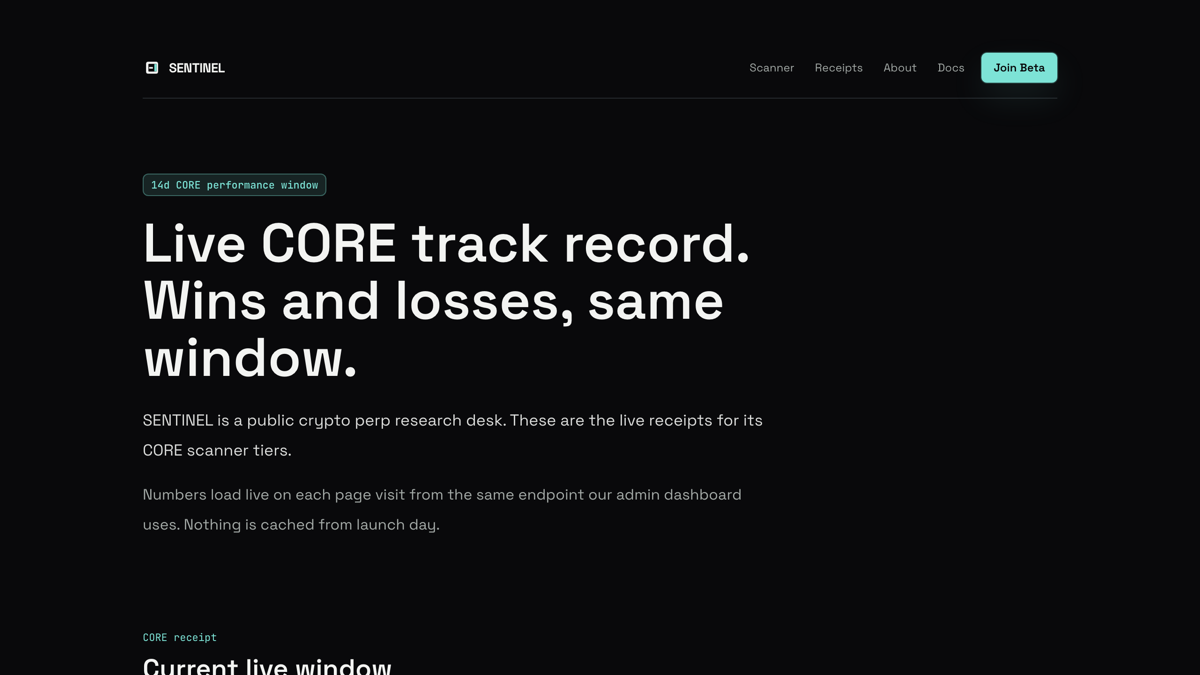
SENTINEL is a crypto perp scanner, not a buy-signal service, and the same standard applies to us. Resolved CORE observations land on public receipt rows, wins and losses on the same page, with the sample size and the worst row visible. The performance page reads live from the resolved record, not from a saved marketing number.
That cuts both ways, on purpose. When the recent resolved CORE cohort is below break-even, the performance page says so plainly rather than hiding it. We would rather you see a true red window than a curated green one, because the entire point of receipts is that you do not have to take our word for it. Open the page, read the losses, judge the process, and decide for yourself.
How to use this checklist
Run the six points against any service, including this one, before money changes hands. If a vendor cannot show you a live record with losses and a sample size, you have not found a track record, you have found an advertisement. The verification is the product decision.
Nothing here is financial advice, and a transparent record is not a promise of future results. It is simply the minimum standard that lets you make an informed choice instead of a hopeful one.
Common questions
How do I verify a crypto signal service before paying?
Ask to see the losing trades, shown at the same weight as the winners, on the same page, for a window you did not pick. Then check that the record is live rather than a screenshot, that the sample size is stated, that the method is written down, and that the service discloses risk honestly.
Are crypto signal groups a scam?
Not all of them, but the market runs on selection: vendors show winning screenshots and hide the losses and the sample size. A service that publishes its full resolved record, including losing trades and a real count, is verifiable; one that only shows curated wins is asking you to trust a marketing deck.
Why do losing trades and sample size matter so much?
Crypto perps are noisy, so a handful of wins can come from luck rather than edge, and the services you hear about are often the ones that happened to run hot. Seeing the losses at equal weight, with the sample size behind them, shows the whole distribution instead of the survivors.
What is the difference between receipts and screenshots?
A screenshot is a claim about the past, edited by the person making it. A live receipt page updates whether the vendor likes the result or not, so a weak window shows up as a weak window. Live and inspectable beats a static image you are asked to trust.
Try it live
Connect wallet first, then continue with Telegram to unlock trial/Core features.
How this was produced
Every claim was verified against the live SENTINEL codebase and the current product surfaces. This is educational product documentation, not financial advice.